Municipal & Town Solar
Put Municipal Property to Work Producing Energy
Towns have a lot of places where electricity gets used: municipal offices, libraries, public safety buildings, schools, garages, water facilities, and more. The best location for solar may be one of those buildings, or somewhere else entirely.
Current Energy works throughout Western Massachusetts to help communities look at their properties, energy use, and options for producing more of their electricity locally.
Start With the Town's Properties and Electric Use
A municipal solar project doesn’t have to begin with a particular building or a predetermined system size.
Start with where the town uses electricity, what property it owns, and what it’s hoping to accomplish.
Where Does Solar Make Sense for a Municipality?
The building with the largest electric bill isn’t necessarily the best place to put solar.
A town may own several buildings, parking areas, open land, and other properties. Looking at those resources together gives us a better chance of finding a site that works well for solar while serving the town’s larger energy goals.
Municipal Buildings
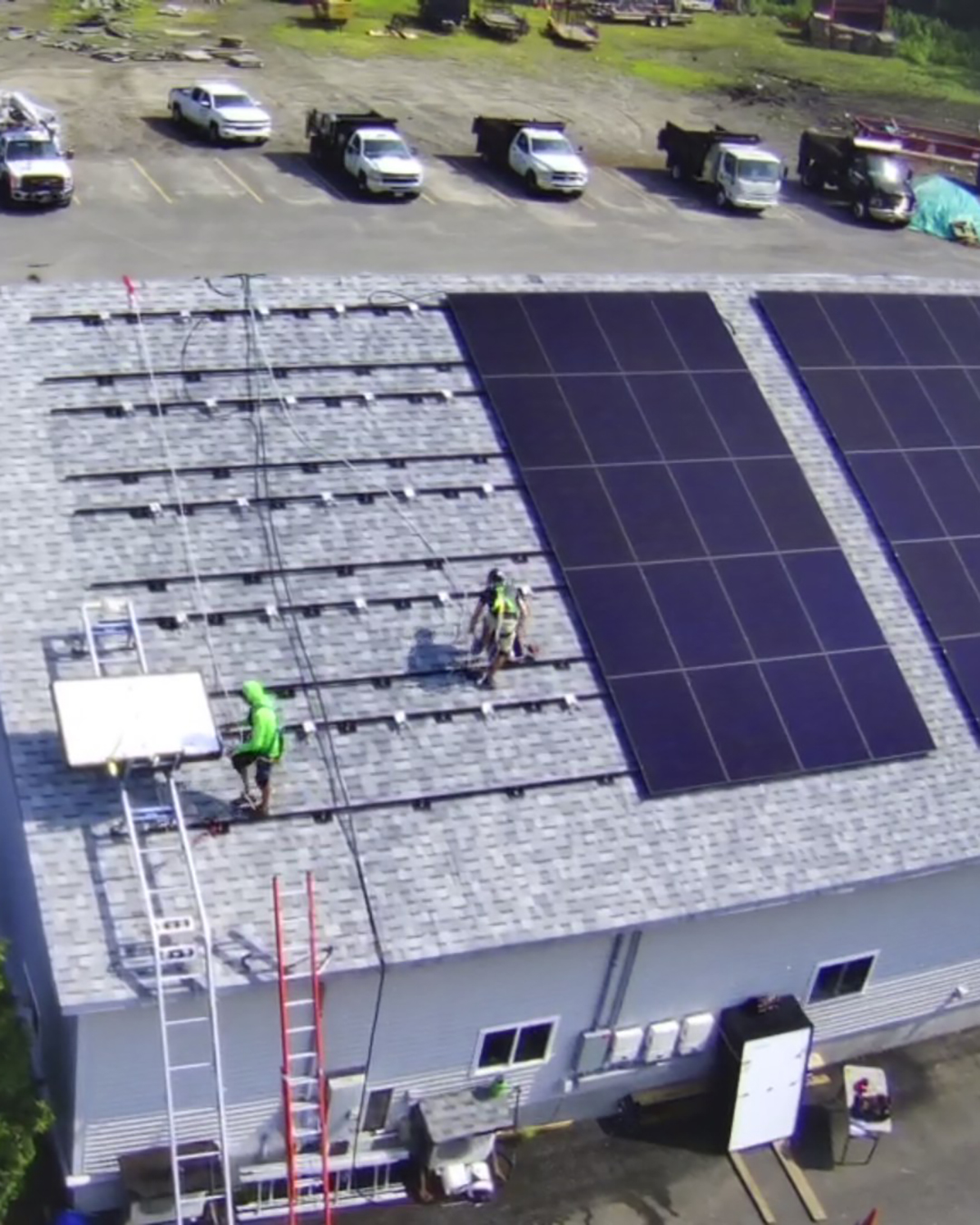
Town halls, libraries, public safety buildings, recreation facilities, and other municipal buildings may all offer opportunities for rooftop solar.
Roof condition, available space, shade, existing equipment, electrical infrastructure, and the building’s long-term plans all matter. A roof that looks large from the ground isn’t automatically the right solar site.
DPW and Public Works Facilities
DPW garages and other public works buildings can be worth evaluating because they may offer larger roofs, open surroundings, or nearby municipal land.
These properties can also have substantial electrical needs of their own. If a town is considering future vehicle or equipment electrification, those plans should be part of the conversation as well.
Schools and Other Public Buildings
Schools often have significant roof area and substantial electricity use. Depending on the building and property, they may be good candidates for solar.
As with any public building, the condition of the roof, electrical system, future renovations, and expected life of the facility need to be considered before determining whether solar belongs there.
Water and Wastewater Facilities
Water and wastewater operations can represent significant municipal electrical loads.
The facilities themselves, nearby land, and the pattern of electricity use may all be worth evaluating when a town is looking at solar opportunities across its properties.
Municipal Land and Closed Landfills
Sometimes the best solar site isn’t a building.
Open municipal land may provide room for a ground-mounted system, and closed landfills have also become solar sites in communities across Massachusetts. The suitability of a particular property depends on its condition, permitted uses, environmental requirements, utility access, and other site-specific factors.
Capped landfills can provide another opportunity for Massachusetts municipalities to consider solar on land with limited options for other uses.
Parking Areas
Municipal parking lots may offer another option through solar canopies.
A canopy can produce electricity without using additional open land while providing covered parking below. It can also create an opportunity to consider public or municipal EV charging as part of the larger project.
One Solar Array. More Than One Town Electric Account.
The best place to generate solar power and the place using the most electricity don’t necessarily have to be the same municipal property.
In Massachusetts, virtual net metering may allow electricity credits from a qualifying municipal solar project at one location to be allocated among other eligible municipal electric accounts.
That can open up possibilities. A good solar site at one town property may potentially help offset electricity used somewhere else.
Eligibility and credit allocation depend on the utility, project, and current Massachusetts net-metering rules.
Public Projects Have a Different Path
A town solar project may need to move through energy committees, department heads, select boards, school committees, public meetings, budgeting, procurement, utility review, and other approvals before construction begins.
That takes time, and it means the project has to make sense to more than one person.
Starting with a clear picture of the town’s properties, energy use, potential solar sites, and project goals can give everyone involved something concrete to evaluate as the project moves forward.
Current Energy is based in Bernardston. We know that smaller Western Massachusetts communities don’t operate like large cities or corporations, and a municipal energy project needs to fit the community undertaking it.
From a Good Solar Site to a Working Municipal Project
Finding room for panels is only the beginning.
A municipal solar project also needs to work with the town’s electricity use, budget, electrical infrastructure, utility requirements, public decision-making, and long-term plans for the property.
Look Across the Town, Not Just One Building
The first step may be looking at several properties rather than choosing one in advance.
Which buildings have useful roof area? Is there municipal land with good solar exposure? Are there roofs that will need replacement soon? Which facilities use the most electricity? Are any properties scheduled for renovation, replacement, or expansion?
That broader look can help narrow the possibilities before significant time is spent developing a project at the wrong location.
Understand the Energy Picture
Municipal electricity use is spread across many different operations.
A library doesn’t use electricity like a wastewater facility. A school has a different schedule from a police station. Streetlights, pumps, offices, garages, and other facilities may all appear on separate accounts.
Understanding that larger picture helps determine what the town is trying to offset and where solar production could be most useful.
Consider Who Will Own the System
Municipalities have historically used arrangements such as power purchase agreements because tax-exempt entities couldn’t directly use federal solar tax credits.
Elective Pay, also known as Direct Pay, has changed that.
Eligible public entities can now potentially receive qualifying federal clean-energy credits as a payment even though they don’t have conventional federal income-tax liability. That makes direct municipal ownership an option worth evaluating rather than assuming a third party must own the system.
Ownership isn’t automatically the right answer for every town. Budget, financing, project risk, long-term responsibility, and the town’s own priorities all belong in the decision.
Ownership Is Worth Another Look
For years, tax-exempt towns couldn’t use federal solar tax credits the way a private business could.
Elective Pay has changed that equation.
Municipal ownership may now be worth evaluating alongside other ways of structuring a solar project.
A Major Change for Municipal Solar
Eligible municipalities and other tax-exempt public entities can use Elective Pay, often called Direct Pay, to receive the value of qualifying federal clean-energy tax credits as a payment.
That means a town doesn’t necessarily have to give up the federal incentive simply because it doesn’t pay federal income taxes.
Timing matters too. Under current federal rules, qualifying solar projects beginning construction now generally need to be placed in service by December 31, 2027 to qualify for the Clean Electricity Investment Credit.
For a municipal project with budgeting, approvals, procurement, utility review, and construction still ahead, that isn’t a lot of time.
Federal rules and eligibility can change. Municipalities should confirm current requirements and the financial treatment of any proposed project with their counsel, accountant, or other qualified advisor.
Understand the State and Utility Programs
Massachusetts municipal solar projects may also interact with programs such as SMART and net metering.
The details can vary based on system size, utility territory, project location, ownership, and current program rules. A landfill project may present different opportunities from a rooftop system on a library or school.
Those programs need to be evaluated using the rules in place when the town is ready to move forward rather than assumptions based on an older project.
Leave Time for the Public Process
Municipal projects tend to have more steps between the first conversation and construction.
Funding needs to be identified. Boards or committees may need to review the project. Public procurement requirements may apply. Utility interconnection and permitting still need to happen.
That doesn’t make municipal solar impractical. It does mean the schedule should reflect the way public projects are approved and funded rather than treating the project like a residential or privately owned commercial installation.
Municipal projects can also involve public bidding, RFP or RFQ processes, prevailing-wage requirements, and approvals that aren’t part of a typical private solar project.
Municipal Solar FAQs
Can a town receive federal solar tax incentives if it doesn't pay federal income tax?
Eligible tax-exempt entities can use Elective Pay, also known as Direct Pay, to receive qualifying clean-energy tax credits as a payment. The rules, registration requirements, deadlines, and eligibility should be confirmed for the specific project.
Can one municipal solar system help offset electricity at several town buildings?
Potentially. Massachusetts virtual net metering can allow credits from qualifying solar generation to be allocated to other eligible electric accounts. The exact arrangement depends on the project, utility, and current net-metering requirements.
What kinds of municipal properties can be considered for solar?
Town halls, libraries, schools, DPW facilities, public safety buildings, water and wastewater facilities, municipal land, parking areas, and some closed landfills may all be worth evaluating. Suitability depends on the individual property.
Can solar be installed on a closed municipal landfill?
Closed landfills have been used for solar projects in Massachusetts, but landfill solar has additional environmental, engineering, permitting, and site considerations. A particular landfill would need to be evaluated before determining whether solar is feasible.
Should a town own its solar system or use a PPA?
There isn’t one answer for every municipality. Elective Pay has made direct ownership more attractive because eligible public entities can potentially receive federal clean-energy credits directly. A PPA or other structure may still be appropriate depending on the town’s budget, financing preferences, and approach to project risk.
How long does a municipal solar project take?
Municipal projects can take longer than privately owned projects because budgeting, public approvals, procurement, permitting, utility interconnection, and construction all have to be coordinated. The schedule depends heavily on the project and the town’s approval process.
Plan for the Property's Future
Solar is long-lived infrastructure.
Before putting a system on a town building, it’s worth knowing whether that roof will need replacement, whether the facility is due for renovation, or whether the town expects its use to change.
The same applies to municipal land. Future development, public use, access, environmental restrictions, and other plans for the property should be understood before committing it to solar.
Start With a Building, a Property, or an Energy Question
You don’t need to have a solar project designed before contacting Current Energy.
Maybe your town has a municipal building with a promising roof. Maybe there’s an unused piece of land, a closed landfill, or a parking area worth exploring. Or perhaps an energy committee is simply trying to understand what solar could do for municipal electric costs.
Tell us what you’re looking at. We can start there.
"*" indicates required fields