
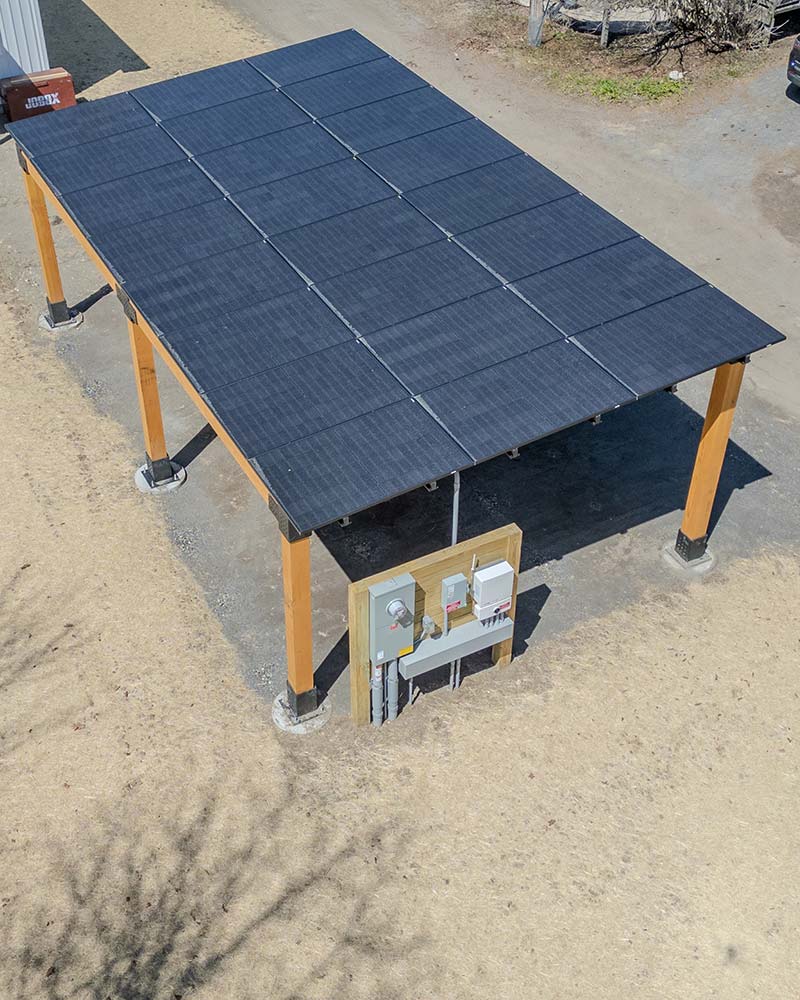
Solar Canopies & Carports
Turn Your Parking Lot Into a Place to Produce Energy
A parking lot already takes up valuable space. A solar canopy gives that same space another job, generating electricity overhead while cars continue to park below.
For businesses, municipalities, schools, and other properties with substantial parking, a canopy can open up possibilities that aren’t available on the roof.
Current Energy works with commercial and public properties throughout Western Massachusetts to explore solar solutions that fit the site, its electrical needs, and the way the property is used.
Look Beyond the Roof
Sometimes the roof is the obvious place for solar. Sometimes it isn’t.
If the property has an aging roof, limited roof area, too much shade, or simply more room over the parking lot, a solar canopy may be worth exploring.
Could Your Parking Lot Be a Solar Site?
A solar canopy uses space the property already needs.
Instead of dedicating open land to a ground-mounted array, the solar system is elevated above parking spaces. Cars, employees, customers, students, or visitors continue to use the area below.
That dual use is the basic appeal. But whether a particular parking lot works depends on much more than its size.
Start With the Parking Area
The layout of the lot matters.
Parking spaces, drive aisles, entrances, pedestrian routes, accessible spaces, delivery areas, fire access, and the way vehicles move through the property all need to be considered.
A canopy shouldn’t make a functioning parking lot harder to use.
Consider the Roof at the Same Time
A canopy isn’t necessarily an alternative to rooftop solar. Some properties may be able to use both.
But parking can become especially interesting when the building’s roof has limitations. It may be too small for the amount of solar the property needs, approaching replacement, heavily shaded, or crowded with HVAC and other equipment.
Looking at the roof and parking area together gives us a better picture of where solar belongs.
Think About How the Property May Change
Today’s parking lot may have different demands five or ten years from now.
A business may add EV chargers. A municipality may begin electrifying fleet vehicles. A school or commercial property may expand. Traffic patterns or parking needs may change.
Those plans are worth discussing before deciding how much of the lot should be covered and where the canopy should go.
Keep Everyday Use in the Design
Clearance matters. So does column placement.
Drivers need room to maneuver. Pedestrians need safe routes through the lot. Delivery and service vehicles may need additional height or access. Snowplows still need somewhere to push snow.
These aren’t secondary details. They’re part of determining whether the canopy works for the property.
Why Does a Solar Canopy Cost More?
With rooftop solar, the building already provides the structure supporting the array.
A solar canopy has to create that structure from the ground up. Foundations, structural framing, engineering, site work, drainage, and the solar equipment itself all become part of the project.
That generally makes a canopy more expensive than putting solar on a suitable roof.
The better question is what the additional investment does for the property. A canopy can create solar capacity without relying on the roof, preserve open land, provide covered parking, and create a natural location for EV charging.
Solar Above. EV Charging Below.
Solar canopies and EV charging are a natural combination.
The canopy creates a place to generate electricity while the parking spaces underneath are already where vehicles spend their time. For businesses, towns, schools, and other organizations considering EV charging, it makes sense to look at the two projects together.
That doesn’t mean every electron produced overhead goes directly into the vehicle plugged in below. It means the solar system, charging equipment, electrical service, and future demand can be considered as parts of the same property.
Planning them together can also help avoid treating EV charging as an afterthought once the solar project is already underway.
Designing a Solar Canopy Around the Property
A canopy brings together several kinds of work in one project.
There’s the solar system itself, but there’s also the structure holding it up, the ground beneath it, the electrical infrastructure serving the property, and the parking lot that needs to keep functioning when the work is complete.
Design for New England Weather
A solar canopy is an outdoor structure with a long working life ahead of it.
In Western Massachusetts, that means accounting for snow, wind, rain, freeze-and-thaw cycles, and the other conditions the structure will experience over the years.
Snow also has to go somewhere. How it moves off the structure, where it accumulates, how the lot is plowed, and where people walk all need to be considered.
Canopy projects can bring additional design considerations, including snow and wind loads, foundations, drainage, vehicle circulation, and the electrical infrastructure connecting the system to the property.
Understand What's Below the Pavement
A canopy doesn’t stop at the surface of the parking lot.
Its supporting structure needs foundations, and existing pavement, underground utilities, drainage, site conditions, and other infrastructure can affect where those supports can go.
Those conditions need to be understood before the final canopy layout is determined.
Bring the Electrical System Into the Plan
The electricity generated above the parking lot still needs to connect to the property.
Existing electrical service, available capacity, equipment location, utility requirements, and the proposed solar system all influence that part of the project.
If EV charging is being added too, the charging load needs to be considered alongside the solar installation rather than treated as an unrelated addition.
Consider Covered Parking Part of the Value
A solar canopy does something rooftop solar can’t: it changes the experience of the parking area below it.
Vehicles gain some protection from direct sun and weather. People can return to cars that have spent less time sitting in full summer sun. Depending on the canopy design, it may also provide some protection from snow and precipitation.
Those benefits don’t replace the energy economics of the project, but they are part of what the additional structure provides.
Look at Available Incentives
Commercial solar canopies may qualify for federal and state solar incentives depending on the project, ownership, location, and rules in effect when the system is built.
Massachusetts has also provided specific incentive treatment for qualifying solar canopies through the SMART program. The details and availability need to be confirmed for an individual project rather than assumed from past program rules.
Municipalities and other eligible tax-exempt entities may have different federal options, including Elective Pay.
It Still Has to Work as a Parking Lot
A successful solar canopy needs to do more than hold panels.
People still have to drive underneath it, park, walk through the lot, clear snow, maintain the property, and use the space every day.
Considering a Solar Canopy? Timing Matters.
Federal incentives remain available for qualifying commercial solar projects, but recent changes have made the project timeline more important.
For solar projects beginning construction now, current federal rules generally require the system to be placed in service by December 31, 2027 to qualify for the Clean Electricity Investment Credit.
That timeline deserves particular attention with a canopy because structural design, site work, permitting, utility coordination, equipment, and construction all need to happen before the system can begin operating.
Federal tax rules and eligibility vary by project and can change. Businesses should confirm current requirements and tax benefits with their tax advisor. Municipalities and other tax-exempt entities should confirm applicable requirements with their own qualified advisors.
Solar Canopy & Carport FAQs
Is a solar canopy a good option if my roof isn't suitable for solar?
It can be. A parking canopy provides another place for solar when a roof has limited space, shade, equipment conflicts, age or condition concerns, or other constraints. The roof and parking area should be evaluated together before deciding which approach is better.
Can a property have both rooftop solar and a solar canopy?
Yes. A property doesn’t necessarily have to choose one or the other. If both areas are suitable, rooftop and canopy solar can potentially be part of a larger system.
Can EV chargers be installed under a solar canopy?
Yes. Parking canopies and EV charging are commonly planned together. The solar system, charging load, electrical infrastructure, and utility requirements all need to be considered when developing the project. Parking canopies can also create a natural place to combine solar generation with EV charging.
Does a solar canopy eliminate parking spaces?
A canopy is intended to preserve the parking function underneath it, but columns, foundations, electrical equipment, accessible routes, and other site requirements can affect the final layout. The existing lot needs to be evaluated before determining how a canopy would fit.
How does snow affect a solar canopy?
The structure needs to be engineered for the environmental conditions at the site. Snow loading, snow shedding, drainage, pedestrian areas, vehicle clearance, and snow removal all need to be considered in a New England installation.
Are solar canopies more expensive than rooftop solar?
Generally, yes. A canopy requires its own supporting structure and foundations in addition to the solar equipment. Whether that added cost is worthwhile depends on the property, available alternatives, energy economics, parking benefits, and whether other infrastructure such as EV charging is being incorporated.
Plan the Installation Around the Lot
Building over an active parking area takes coordination.
Parts of the lot may need to close temporarily for foundations, structural work, electrical installation, and equipment access. For a business or public facility, that work needs to be considered alongside customer parking, employees, school schedules, public access, deliveries, and normal operations.
How the property needs to function during construction should be part of the planning.
Let's Take a Look at Your Parking Lot
You don’t need to know how many panels will fit, where the columns should go, or what kind of canopy structure the property needs.
Tell us about the site, the parking area, how the property uses electricity, and whether EV charging is part of your plans.
We’ll start by looking at whether a solar canopy is worth exploring.
"*" indicates required fields