
Maybe you’re already thinking about solar for your Keene‑area home. Maybe you’re also eyeing an electric car the next time your current vehicle ages out. At some point those two ideas meet in the same sentence: “If I’m going to do solar and an EV, what does that mean for my wiring and electrical panel?”
In Southwest New Hampshire, the homes most ready for this shift aren’t always the newest ones. They’re the ones where someone has taken the time to think through the electrical backbone—service size, panel layout, and where things will plug in—before bolting anything to the roof.
Table of Contents
ToggleWhy your panel matters as much as your panels
Most older homes around Keene, Swanzey, Walpole, and Winchester were never wired with EVs and solar in mind. A 60‑ or 100‑amp service might have made sense when the house had a few outlets, some lights, and maybe an electric range. Add heat pumps, a Level 2 charger, and a decent‑sized solar inverter, and that same panel can start feeling crowded.
New Hampshire–focused solar and energy guides point out that many homes headed toward electrification will eventually need 200‑amp service or better, especially if they plan to support EV charging and more electric heating. Even if code technically allows a smaller service to limp along, the everyday reality can be constant juggling of what’s running at the same time.
That’s why, when you’re thinking about solar and an EV together, the first question isn’t “How many panels?” or “Which car?” It’s “What does my electrical panel look like, and how much room do I really have to grow?”
Level 1 vs. Level 2: how much charging are we talking about?
EV charging at home comes in two broad flavors:
- Level 1: Uses a standard 120‑volt outlet. It adds range slowly—often 3–4 miles of range per hour—but can be enough for light daily driving.
- Level 2: Uses a 240‑volt circuit, typically 30–50 amps. It charges much faster, often 20–30+ miles of range per hour, and is what most daily drivers eventually want.
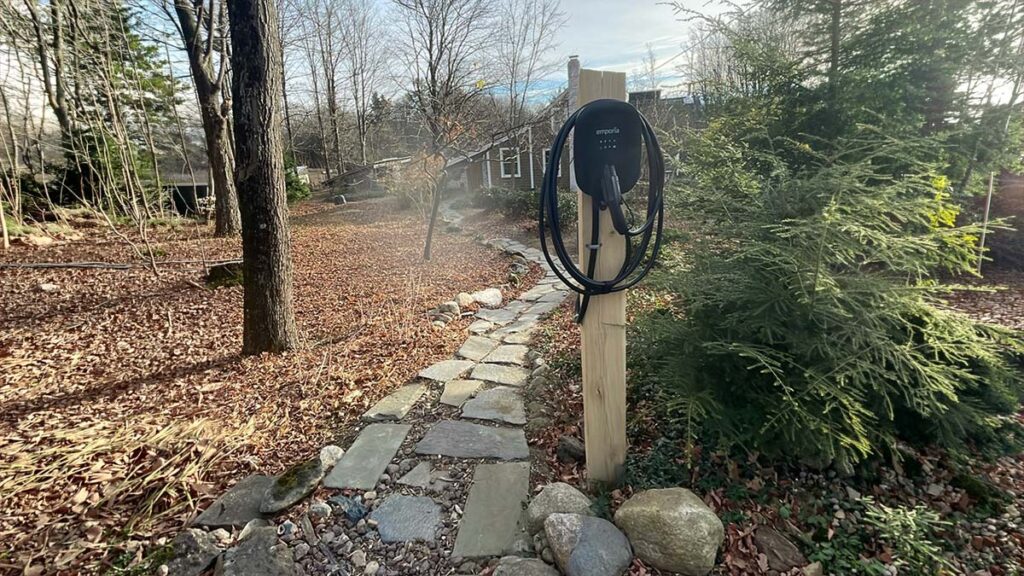
For an older Keene‑area home, a Level 1 setup might be as simple as a dedicated outdoor outlet on an existing circuit. A Level 2 charger is different: it usually needs a new breaker, adequate panel capacity, and a good spot to run conduit to the driveway or garage.
If you’re planning solar and know you’ll want Level 2 charging, that charger is essentially another large appliance in your load calculation. It needs to be reflected in how you size your service, your panel, and the solar system that will help feed it.
How solar interacts with EV charging in real life
It’s tempting to think of EV charging as “using solar directly,” but in practice, your car and your array don’t always talk in real time.
For many owners:
- The car is away from home during the middle of the day, when solar production is highest.
- Charging happens in the evening, when panels are winding down or already off.
That’s where net metering and good design come in. Over a year, solar can still generate enough electricity to cover much of the energy your EV uses, even if the actual charging happens at night. The grid acts as the “battery in between,” crediting you when you over‑produce and supplying you when you charge.
Design‑wise, that means two things:
- Your system size should account for the extra kilowatt‑hours you’ll put into the car each year.
- Your electrical panel and wiring should be ready for the EV circuit whether you buy the car this year or in a few years.
The goal isn’t to choreograph every watt perfectly; it’s to make sure your system as a whole can handle the loads you’re planning to add.
Planning your electrical system with both in mind
When we look at a Keene‑area home that’s aiming for solar + EV, we tend to think in three layers.
First is service size and panel capacity. Does the house have enough amps coming in from the street, and enough physical space in the panel, to support a solar inverter, a Level 2 charger, and whatever else is in the mix—heat pumps, electric range, dryer, well pump, etc.? If the answer is “barely” or “no,” upgrading service and panel becomes part of the plan, not a surprise later.
Second is layout. Where will the EV charger go relative to the panel? Can we run a clean conduit path without carving up finished spaces? Where will the inverter and any disconnects live so that everything is tidy, accessible, and in line with code?
Third is future‑proofing. Even if you’re starting with one EV and no battery, it’s smart to:
- Leave room in the panel for additional circuits.
- Route conduit in ways that make adding a second charger or battery simpler later.
- Size wiring appropriately if you think a higher‑amp charger might come later.
The cost of thinking ahead is modest compared with opening walls again or reworking a crowded panel down the road.
Do you need a battery to make solar and EV charging “worth it”?
In the Keene area, batteries are often discussed in the context of outages and resilience, not just EV charging. A battery can help you ride through ice‑storm blackouts and, in some cases, help manage peak loads or time‑of‑use rates.
You don’t need a battery for solar and an EV to make sense together. Many homeowners are well served by:
- A right‑sized solar array.
- A panel and service upgrade that can comfortably host an inverter and Level 2 charger.
- Smart choices about when they charge (for example, using a scheduling feature to charge during off‑peak hours if their rate structure rewards it).
A battery starts to make more sense if:
- Outages are frequent or especially disruptive where you live.
- You want to keep charging an EV during grid outages, even at a reduced rate.
- You’re trying to manage demand charges or time‑varying rates in a more sophisticated way.
The important thing, even if you don’t buy a battery now, is to design your electrical system so adding one later doesn’t mean starting over.
A practical order of operations for Keene‑area homeowners
If you’re in Keene or the surrounding towns and you’re serious about both solar and an EV, a simple, grounded sequence looks like this:
- Get your panel and service evaluated.
Have someone look at your existing service size, panel make and model, and how full it really is once you account for major loads. - Decide where the charger will live.
Think about how you park most of the time, whether you need charging in a garage or outside, and how you’ll use cords and cable management day to day. - Size solar with the EV in mind.
Estimate how many miles you drive and how much of that charging will happen at home. Use that to inform system size, rather than bolting on solar and hoping it covers “some of it.” - Design wiring and conduit for tomorrow, not just today.
Run conduit in ways that keep future additions simple. Leave space in the panel. Think about where a second charger or a battery would physically go.
Handled this way, solar and EV charging become two parts of the same investment in your home’s electrical backbone, not competing projects.
The bottom line for Keene‑area homes
In and around Keene, solar and home EV charging are only going to become more common. The homes that handle that transition gracefully aren’t necessarily the newest ones; they’re the ones where someone took the time to get the wiring, panel, and layout ready before the hardware arrived.
If you treat your electrical system as the foundation—service size, panel, conduit, and planning—solar and an EV can slot into place much more easily and keep working together for the long haul, even through the storms and seasons Southwest New Hampshire throws at you.