
For many Pioneer Valley homeowners, the hesitation around solar isn’t about value. It’s about uncertainty. You can picture the finished result, panels in place, a lower electric bill, but the stretch between “I’m interested” and “it’s live” feels abstract.
In reality, the process is more straightforward than it looks. It unfolds in stages. The details shift depending on the house and the town, but whether you’re in Northampton, Amherst, Easthampton, Hadley, or farther up the valley, the sequence is familiar.
Table of Contents
ToggleStep 1: A real look at your house and your bills
Every project begins with the physical house and the way electricity is actually used inside it.
That first conversation should revolve around a full year of electric bills. Not just a recent month. Twelve months tells the story of winter heating, summer cooling, shoulder seasons, and any spikes from workshops, well pumps, or electric vehicles. If you’re planning to add heat pumps or an EV, that matters now, not later. Designing around a fictional “average home” is how systems get undersized.
Then someone needs to see the site in person.
Roof age and condition come first. A roof that’s five years from replacement needs a different plan than one replaced last summer. Orientation and tilt are evaluated, but so is real-world shading, trees that leaf out in May and drop leaves in October, neighboring houses, dormers. In many Pioneer Valley homes, the basement or utility room matters just as much as the roof. The electrical panel tells its own story. If the service is older or crowded, that becomes part of the design discussion immediately.
This stage is practical. It isn’t a sales pitch. It’s reconnaissance.
Step 2: Design, pricing, and a plain-English proposal
Once the house and usage are understood, modeling begins.
Behind the scenes, production is estimated using local weather data, shading inputs, and utility rules specific to your area. You should see annual kilowatt-hour projections that reflect Pioneer Valley conditions, not an optimistic national average. Those numbers are compared against your real usage, including any planned changes.
Cost breakdowns follow. Equipment, labor, permitting, incentives, tax credits. A clear proposal separates these pieces rather than blending them into a single headline number. Savings projections should be conservative enough that you can explain them without sounding like you’re reciting a brochure.
This is also when options surface. A roof mount may be ideal, but if you have open land, a ground system might produce more. Equipment choices can shift monitoring, warranty terms, or future expandability. Some homeowners want to leave space for a battery later. Others prefer to size everything at once.
A strong proposal feels grounded. You should be able to summarize it at a coffee shop without flipping through fine print.
Step 3: Permits, paperwork, and utility approvals
After design approval, the visible momentum slows. Most of the work moves into paperwork.
Building and electrical permits are submitted to your town or city. In the Pioneer Valley, that could mean Northampton, Amherst, Easthampton, Hadley, South Hadley, or a smaller town with its own process and timelines. Inspectors need drawings, equipment specs, and load calculations before installation can begin.
At the same time, an interconnection application goes to the utility. That application allows your system to connect to the grid and participate in net metering. The homeowner shouldn’t be chasing these approvals. Updates should come to you, submission confirmed, approval received, revision requested if necessary.
This stage can stretch depending on how busy municipal offices and utilities are. It’s quiet. It’s administrative. It’s essential.
Step 4: Installation days – what actually happens at your house
When installation day arrives, it’s less dramatic than people expect.
Most homes in the Pioneer Valley are done within a couple of days. Occasionally it’s quicker. Occasionally it runs longer if there’s a panel upgrade or the weather decides not to cooperate. Snow, wind, and steep roofs can slow things down.
The first hour is usually orientation. The crew checks the layout against the plan, confirms panel placement, inverter location, and conduit paths, then starts staging equipment. After that, it becomes steady, physical work.
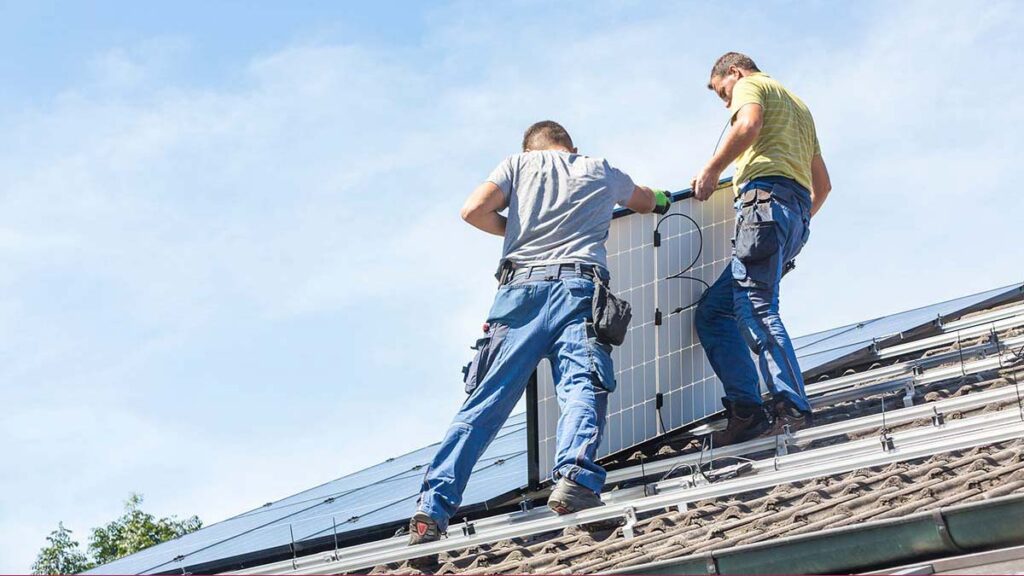
You’ll notice movement on the roof early. Rails go down first. Then panels follow. It doesn’t happen all at once. Inside, someone is almost always near the electrical panel. Conduit gets routed. Connections are made. If a service upgrade is part of the job, there will be a planned shutoff for a short period. It’s inconvenient for a bit, then power comes back.
There isn’t much disruption beyond that. Most indoor activity stays contained to the basement or utility area. Outside, the array gradually takes shape. By the end, it looks complete, though it won’t be turned on yet.
For a few days your house feels active. Then the trucks pull away and everything looks like it always did, except there are panels on the roof.
Step 5: Inspections, meter work, and “permission to operate”
After installation wraps up, inspectors step in.
Local building and electrical officials verify that the work matches the approved plans and complies with code. They examine roof attachments, grounding, labeling, and safety shutoffs. Once the town signs off, the utility schedules meter work.
That meter update is critical. The utility either installs a new bi-directional meter or reprograms the existing one so it can measure both incoming and exported electricity. At some point during this process, you receive a formal “permission to operate,” often abbreviated as PTO. It’s usually just a short notice, but it’s the signal that the system can be energized.
Only after PTO do you flip the switch.
Step 6: Turning it on and living with it
The activation moment is understated. There’s no ceremony. The inverter powers up. A monitoring app comes to life. On a sunny day, you may see production immediately offsetting household usage.
In the weeks that follow, you’ll begin to understand the rhythm of your own system. Production rises and falls with seasons. Bills reflect net metering credits differently depending on the time of year. A single month rarely tells the full story; full seasons do.
Most Pioneer Valley homeowners settle into a simple habit. They glance at the monitoring dashboard occasionally. They notice when a clear spring day produces more than expected. They stop thinking about the system most of the time. It becomes background infrastructure.
The ongoing responsibility is minimal, watching for new shading from tree growth, clearing debris if necessary, and keeping an eye on performance trends over time.
What matters most in the Pioneer Valley version of this story
The mechanical steps of residential solar, assessment, design, permitting, installation, inspection, look similar across New England. What shifts here is context.
Older housing stock means electrical panels often need attention. Mature tree cover introduces real shading considerations. Snow and seasonal weather patterns influence design decisions and production curves. The way people in Northampton or Amherst heat and use their homes isn’t identical to a suburban template elsewhere.
The most important decisions happen early. Understanding your usage. Being realistic about roof condition or yard space. Making sure the design reflects how homes in the Pioneer Valley actually function.
Once that groundwork is set, the rest of the process follows a clear sequence that hundreds of valley homes have already navigated. Knowing what to expect removes most of the mystery. It turns the “black box” into a checklist that unfolds, one stage at a time.