
If you run a business anywhere in Western Massachusetts, energy probably doesn’t feel like a background expense anymore. It’s visible. It moves. Rates change. Storms interrupt service. And if you’re thinking about adding heat pumps or EV chargers, the electric line on your budget is not getting smaller.
That’s why more owners from Deerfield up through Northfield are taking a serious look at commercial solar. In some cases, storage gets added to the mix. Not because it sounds forward-thinking. Because it addresses real operating pressure.
You don’t need to own a massive warehouse for it to make sense. In fact, many strong candidates are smaller, owner-occupied buildings — professional offices, clinics, trades shops — where the person paying the electric bill also controls the roof.
Table of Contents
ToggleWhy Western Massachusetts is a good fit for commercial solar
Western Massachusetts sits in a practical middle ground. We receive solid annual solar production for our latitude. Electricity prices are not low. And state-level incentives still layer on top of federal tax credits. None of that guarantees a win. But it creates conditions that often support one.
A properly sized commercial system here can offset a meaningful portion of annual electric use. It can also reduce exposure to future rate increases, which matters more than most people admit. What many owners end up valuing most, though, is predictability. You stabilize part of your energy supply instead of watching the entire bill float.
Snow doesn’t undo that math. Solar systems in colder climates like Wisconsin and Minnesota perform well because they’re engineered for real winter conditions — load ratings, tilt angles, drainage. Western Massachusetts falls squarely in that category. Most production happens between spring and fall anyway. Winter contributes less to the yearly total than people expect.
What makes this region distinct is the building mix.
In Greenfield, Turners Falls, and Shelburne Falls, you’ll find older storefront buildings with apartments above. These weren’t designed with solar in mind, yet many can accommodate it with careful planning. On the edges of town sit standalone professional buildings — dentists, doctors, veterinarians, accountants — often with simple rooflines and steady loads. Then there are small manufacturers and trades operations from Deerfield toward Northfield, operating under metal or membrane roofs with heavier daytime demand.
Each type can work. The design approach just shifts.
A quick note on 2026 federal incentives for businesses
The 30% federal Investment Tax Credit remains available for qualifying commercial solar projects. For many Western Massachusetts businesses, this is the largest single financial lever in the project.
Timing matters.
If construction begins in 2026 — or equipment is properly safe-harbored — and the project is placed in service by the end of 2027, the credit generally applies to 30% of the installed cost. That percentage applies to the whole system, not just the panels.
Put that in perspective. A $200,000 commercial solar project could generate roughly $60,000 in federal tax credit. That’s before depreciation is considered. It’s also before state-level programs enter the equation.
Missing the timing window changes the math. Starting after the mid-2026 threshold or failing to place the system in service by the end of 2027 likely removes access to the credit for that installation.
Because it’s a business credit, it can also stack with accelerated or bonus depreciation. In some situations, additional incentives tied to equipment sourcing or project characteristics may apply. The details vary. A CPA should be involved early, not at the end.
The simple takeaway is this: beginning a project in 2026 keeps the 30% federal credit available. After that, the landscape could shift.
The kinds of commercial roofs and properties that lend themselves to solar
Owner-occupied professional buildings
If you own a one- or two-story office building — dental, veterinary, accounting, legal — you’re often positioned well for commercial solar. The reason is straightforward. You carry the long-term operating costs.
Electric usage in these buildings is usually steady. Lighting. HVAC. Computers. Lab or medical equipment. It doesn’t swing dramatically from month to month, which makes system sizing more precise.
Across Greenfield, Deerfield, Sunderland, and Northfield, many of these properties have simple pitched or modest flat roofs with workable surface area. Design needs to consider snow shedding, rooftop mechanical units, parapet shading, and future electrification plans. But these constraints are manageable.
Parking areas add flexibility. EV charging later becomes easier when conduit planning happens during the initial build.
Solar in this setting is rarely about aesthetics. It’s about infrastructure.
Small manufacturers, trades shops, and warehouses
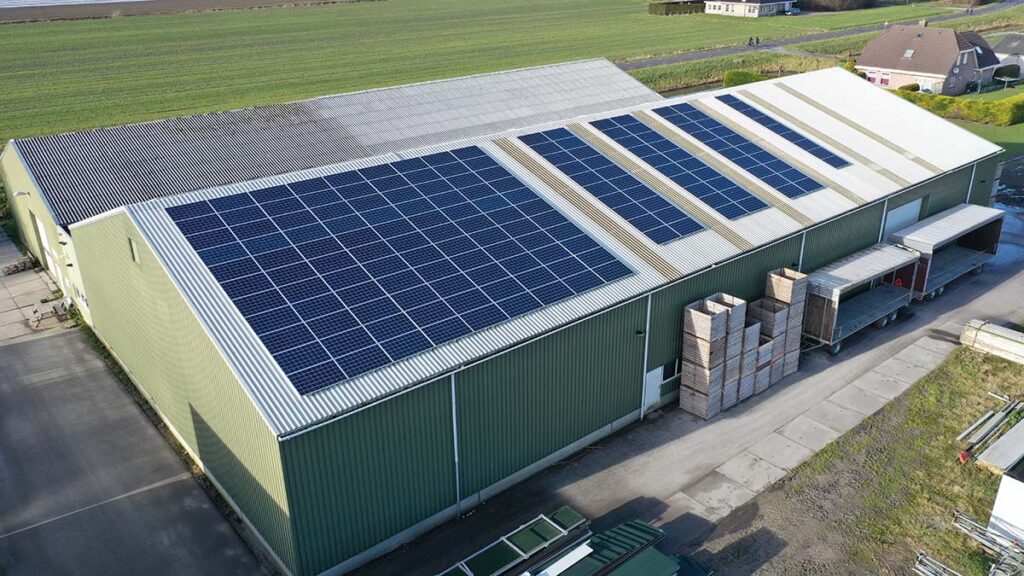
Franklin County has a wide range of light industrial buildings. Fabrication shops. Distribution spaces. Trades operations. Many run meaningful electrical loads during working hours.
In regions with similar building stock, rooftop solar has helped stabilize long-term energy costs and soften exposure to demand charges. The same principle applies here.
A properly designed system on a shop or warehouse roof can offset a large share of daytime usage when equipment is running. It can also prepare the building for storage integration later if resilience becomes a priority.
Not every roof is viable. Structural limits or heavy mechanical clutter sometimes make rooftop systems impractical. In those cases, ground mounts or solar carports often become the better solution.
The key is adaptation, not forcing a design where it doesn’t fit.
Rural properties and edge-of-town lots
On the outskirts of Deerfield, Conway, Sunderland, and Northfield, commercial properties often have land available. When that’s true, ground-mounted arrays may outperform rooftop systems.
Tilt can be optimized for annual production and snow shedding. Placement can prioritize sun exposure rather than building footprint. Foundations can be engineered for frost depth and local load conditions.
Some of these sites are agricultural operations. Others are storage yards or industrial spaces with excess acreage. Where farms are involved, agrivoltaic strategies may enter the conversation. That discussion usually belongs in a deeper farm-specific analysis.
What rural sites offer is flexibility. Design doesn’t have to fight architecture.
Where batteries and smart electrical work come in
For certain customers, solar addresses only part of the picture. It reduces annual consumption. It does not control timing. And it does not maintain power during outages.
Storage and electrical upgrades handle those dimensions.
Across colder regions, batteries are increasingly integrated into commercial projects to address demand spikes and grid interruptions. Western Massachusetts presents similar conditions.
Solar affects how much energy you buy. Storage influences when you buy it — and whether you need to.
Taming demand charges
Commercial rate structures often include demand charges based on the highest short-term power draw during a billing cycle. A brief surge can set that number for the month.
Batteries can help flatten that profile. They charge when building demand is lower, then discharge during spikes. The total annual consumption may not change dramatically. The billing structure does.
For a small manufacturer in Greenfield or a busy clinic in Deerfield, that shift can matter. Solar alone trims kilowatt-hours. Storage can reshape how those kilowatt-hours are priced.
It’s less dramatic than marketing suggests. It’s also more practical.
Keeping critical loads on during outages
Winter weather in Western Massachusetts still disrupts service. Ice and wind are part of the regional reality.
A battery paired with solar will not power an entire facility indefinitely. That isn’t the intent. Instead, systems are configured around selected loads — refrigeration, networking equipment, essential lighting, certain medical devices.
During an outage, the building shifts into a reduced but functional state.
For medical or dental offices storing temperature-sensitive materials, that distinction is significant. For veterinary clinics, it may be critical. For any operation that cannot simply close and wait, resilience becomes more than a convenience.
Storage is less about comfort than continuity.
Getting the electrical backbone right
Many Western Massachusetts commercial buildings predate modern electrical demands. Service panels may be undersized. Circuit distribution may not align with backup priorities.
That’s why panel upgrades and circuit reconfiguration are often part of these projects. Proper load separation ensures batteries support the circuits that actually matter. Planning conduit and capacity for future EV charging or electrified HVAC avoids rework later.
These improvements aren’t visible from the street. They determine whether the building becomes more adaptable or more constrained.
An electrician-led design approach focuses on that foundation first.
How businesses from Deerfield to Northfield might approach a project
If you own your building in Western Massachusetts and are considering commercial solar, the best first step is clarity.
Define what you want to accomplish. Cost control. Storm resilience. Electrification readiness. Each objective influences design.
Then evaluate the building honestly. Roof condition. Orientation. Shading. Available land. Electrical service capacity. Some projects stall not because solar is wrong, but because the infrastructure underneath it needs attention.
Next, review real usage. Twelve months of utility data is a starting point. Understand when you consume power and how your tariff calculates charges. Only after that should incentives be layered in.
The 30% federal ITC for projects beginning construction in 2026 and placed in service by the end of 2027 remains significant. Depreciation and state programs affect cash flow differently depending on ownership structure.
Finally, match system size to your ownership horizon. Long-term owners can justify more comprehensive upgrades. Shorter timelines may call for a narrower approach focused on immediate cash flow and property value.
Businesses in Deerfield, Sunderland, Greenfield, or Northfield don’t need to replicate large urban projects. The regional context is different. Still, lessons from other cold-climate and rural markets can help avoid oversizing or undersizing.
The right system isn’t the largest one. It’s the one aligned with the building, the business, and the years you expect to hold both.
What to do next if you own a commercial building in Western MA
If you own a clinic, office, shop, warehouse, or small industrial building anywhere from Deerfield to Northfield, the next step is a grounded assessment.
Look at your roof or land. Review your bills. Confirm the incentive timeline. Understand your long-term plans.
An initial evaluation should clarify usable area, approximate system size, projected production under Western MA conditions, and how solar — with or without storage — could influence operating costs over the next decade or two.
From there, you decide. Move forward. Stage improvements. Or wait.
The key is that the decision is informed, not reactive.