
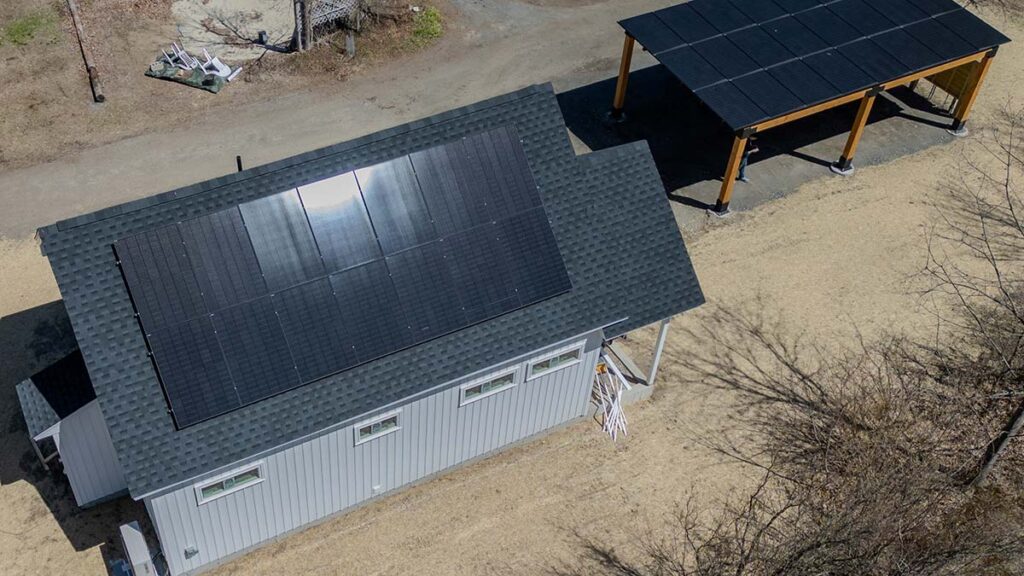
If you live in Franklin County, you probably have more trees, hills, and quirks in your yard than the average solar brochure shows. Maybe your roof faces the wrong way, or it’s chopped up with dormers. Maybe you’ve got plenty of open land but you’re not sure you want a row of panels in the meadow. When you start looking at solar, the question comes quickly: should the panels go on the roof, or does a ground‑mount actually make more sense here?
There isn’t a one‑size‑fits‑all answer. Rural homes in Ashfield, Conway, Deerfield, Sunderland, Northfield, and the hilltowns often have very different trade‑offs than a house on a tight city lot. The right choice comes down to what your roof can realistically do, what your land can offer, and what you want to live with over the long term.
Table of Contents
ToggleWhat roof‑mount solar does well on rural Western MA homes
Roof‑mounted solar is what most people picture first, and on the right house it’s still the simplest, most cost‑effective option. In Franklin County, that often means a home with one or two clean roof planes that face somewhere between southeast and southwest, without big trees immediately in front of them.
On a good roof, panels take advantage of structure you already have. There’s no need to pour piers or run long trenches across the yard. Wiring runs are shorter, hardware is simpler, and installers know exactly how to flash and seal penetrations for our snow and freeze‑thaw cycles. That usually keeps the price per watt lower than a comparable ground‑mount.
Roof‑mounts also hide the system in plain sight. If you’d rather not see rows of panels from your kitchen window or the road, solar that hugs the roofline can feel more “part of the house” and less like a separate structure.
The catch is that a roof‑mounted system inherits all of your roof’s limitations. If the best plane faces east, is shaded by a neighbor’s maple, or needs to be replaced in five years, those limits come with the project.
When the roof starts to fall short
Rural Franklin County homes have a few recurring roof problems when it comes to solar.
Some roofs simply point in the wrong direction. A beautiful cape in Conway with a big north‑facing front and a small south‑facing back may only have room for a modest array. Tall trees can be even harder to work around; if your best roof plane looks straight into a stand of oaks in Sunderland or a hemlock windbreak in Ashfield, you may never get the production you expect, especially in the shoulder seasons.
Roof age and condition also matter. A thirty‑year‑old roof in Northfield that’s already on its second layer of shingles is a risky place to mount a long‑lived solar array. You don’t want to bolt twenty‑five‑year equipment onto a roof that will realistically need replacing in five or ten. And older framing may need to be checked for snow‑load capacity before you add both panel weight and winter snow.
Complex roofs are the third issue. Dormers, valleys, multiple rooflines, chimneys, skylights—each of these eats up space and can cast shadows on panels at certain times of day. It’s not that solar is impossible on those roofs; it’s that the usable area shrinks, and design gets more complicated.
If you’re running into two or three of these problems at once, that’s when it’s time to take a serious look at the ground.
What a ground‑mount can do that a roof can’t
A ground‑mounted array is essentially its own little building. That sounds like more work—and it is—but it also means you’re no longer stuck with whatever your roof gives you.
On a rural lot, you can choose a spot that actually sees the sun: the edge of a field in Deerfield, the open section of a yard in Sunderland, a clearing above the house in Ashfield. You can set the tilt you want for snow shedding and year‑round production instead of accepting whatever pitch your roof happens to have. You can aim the array due south, even if your roof points east‑west.
Because you’re building from scratch, the structure can be engineered for Western MA’s snow and frost conditions—piers below frost depth, row spacing that lets snow slide and accumulate without burying the lower edge. Maintenance is also different: panels are at ground‑accessible height, which can make it easier to inspect wiring, clean off unusual debris, or manage vegetation underneath.
All of that flexibility usually comes with a higher up‑front cost per watt than a straightforward roof system, mainly because you’re paying for foundations, posts or racking, and often longer trenching back to the house. But on a site where the roof is mediocre and the ground is excellent, that extra investment can pay for itself in better production and less compromise.
Living with a ground‑mount day to day
The other half of the ground‑mount question isn’t technical; it’s about how you want your property to feel.
A well‑placed array can tuck along a tree line or sit in a corner of a field without dominating the view. A poorly placed array can feel like a fence across your favorite stretch of lawn. Mowing, snow‑blowing, and moving equipment around the structure all need to be thought through. In some hilltowns, you’ll also want to consider how visible the array will be from neighboring properties or from the road, and whether local bylaws have specific requirements.
For some Franklin County homeowners, the trade‑off is easy: “I’d rather see panels in the back field than cut down the maples by the house.” For others, sacrificing a sunny patch of open land feels worse than working with a smaller roof system. Neither instinct is wrong; it just needs to be part of the conversation up front.
A simple way to decide which path to explore first
When you strip away all the details, rural homeowners here are usually weighing the same three questions:
- Is my roof truly solar‑ready?
If your roof is young, faces reasonably south, has minimal shading, and has clean planes to work with, it’s almost always worth starting with a roof‑mounted design. You may never need a ground‑mount at all. - Do I have good ground options that I actually like?
If your roof is a tangle of problems but your land has one or two sunny spots that you wouldn’t miss, ground‑mounts deserve a serious look. - How much power do I want long term?
If you’re planning to electrify everything—heat pumps, hot water, cooking, EVs—you may outgrow what your roof alone can support. In those cases, a hybrid plan (roof now, ground later) can be the most flexible.
A lot of Franklin County projects end up as hybrids. A homeowner in Deerfield might fill the best roof plane now and leave room in the design for a future ground‑mount when they’re ready to add an EV. Someone in Conway might do a modest roof array and a small ground‑mount at the same time so they can cover a big share of a nearly all‑electric house from day one.
How to start the conversation for your property
If you’re trying to decide between roof‑ and ground‑mounted solar, a few pieces of information will make that first conversation much more useful:
- Recent photos of the house and the parts of your yard you’d consider for an array.
- A sense of your roof’s age and any upcoming roofing work.
- A year or two of electric bills, plus any plans to add heat pumps or an EV.
From there, a good site visit and shading analysis will usually make the answer obvious. In some Franklin County yards, the roof is clearly the best option. In others, the roof is a compromise and the ground is the path to a system that actually matches how you want to live.
Either way, the goal is the same: a solar setup that fits your house, your land, and your long‑term plans, instead of forcing your property into a shape it was never meant to have.