
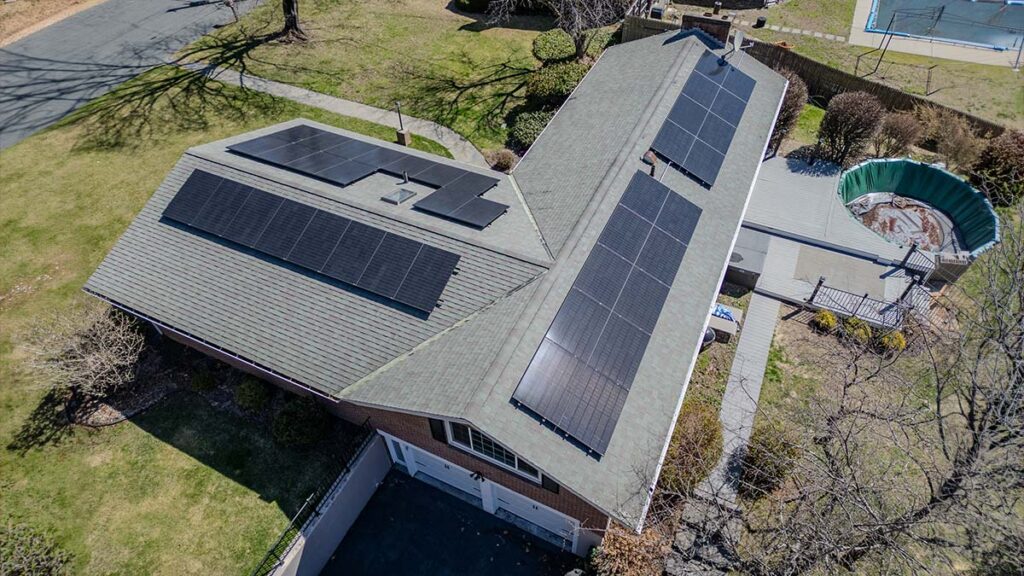
At some point in every solar conversation, a Northampton or Amherst homeowner leans back and asks the real question: “Okay, but how much solar do I actually need?” They’re not asking for a panel count. They’re asking, “What size system makes sense for my house, my bills, and my plans?”
There’s no single “typical” Pioneer Valley home, but there is a practical way to think about system size that doesn’t require you to become an engineer. It starts with what you use now, where you live, and how you expect your electric life to change over the next decade.
Table of Contents
ToggleStart with your actual electric usage, not a guess
The most useful document in this whole process isn’t a solar brochure; it’s your electric bill. If you live in Northampton, Amherst, Easthampton, Hadley, or South Hadley, grab 12 months of bills and look for the column that shows kilowatt‑hours (kWh) used each month.
Patterns matter more than any one number. Maybe your usage spikes in summer because of window ACs or minisplits. Maybe winter is higher because of electric heat or space heaters. Maybe your bills jumped when you started working from home. Those clues tell us what kind of house we’re dealing with and how much “normal” looks like for you.
From there, we can talk in ranges. A small, efficient home with one or two people might average 400–500 kWh a month. A larger, busier home with multiple occupants, home offices, and more gadgets might be closer to 800–1,000 kWh or more. The point isn’t to hit an exact bullseye; it’s to make sure we’re sizing for the life you’re actually living, not a made‑up average.
Where you live in the valley matters, but not as much as you think
Pioneer Valley marketing sometimes makes it sound like every town has completely different solar potential. In reality, the difference in annual sun between a good roof in Northampton and a good roof in Amherst, Hadley, or Easthampton is small compared to differences in site quality—orientation, tilt, shading, and roof layout.
A south‑facing, lightly shaded roof in Florence or Cushman is going to outperform a heavily shaded roof anywhere in the valley. A well‑sited ground‑mount on a sunny edge of a Hadley field can easily outproduce a compromised roof system in downtown Northampton.
So when we talk about “how much solar you need,” what we really mean is, “how much production can we reasonably expect from your specific roof or yard, and how does that line up with your usage?”
Think in coverage bands, not perfection
One of the most helpful mental shifts is to stop aiming for a magical 100% offset and start thinking in coverage bands.
For many Pioneer Valley homes, it makes sense to aim for a system that covers 60–90% of annual electric use based on today’s numbers. That range gives you room for the seasons, bad weather, and future changes without forcing the system into strange contortions.
You might choose to:
- Size closer to the low end if your roof is limited, your budget is tight, or you expect to move sooner.
- Aim toward the higher end if you have a strong site, higher usage, and long‑term plans to stay put.
The important part is that you’re choosing that range based on your actual bills and your site, not chasing a round number because it looks good on paper.
How future plans change the answer
In the Pioneer Valley, very few homeowners are planning to use less electricity over the next ten years. More often, they’re saying things like:
- “We’d like to add heat pumps so we can get off oil or propane.”
- “One of us will probably be working from home full‑time.”
- “Our next car will probably be an EV.”
Each of those moves pushes electric usage up. If you size solar only for today’s loads and then pile those changes on top, you can outgrow your array quickly. On the other hand, oversizing wildly for a future that may never happen isn’t smart either.
The middle path is usually to be explicit about your plans. If you’re serious about heat pumps in the next few years, we can estimate what they’re likely to add based on your current fuel usage and house type. If an EV is a “definitely soon” purchase, we can add a reasonable allowance for home charging. Then we can show you side‑by‑side scenarios:
- A system sized just for today.
- A system that assumes partial or full electrification.
- A hybrid approach that covers today and a good chunk of tomorrow, with the option to expand later via a ground‑mount if needed.
That way, you’re making a conscious choice about how much future you’re buying into the system, instead of being surprised later.
Roof vs. ground: does it change “how much”?
For a lot of Northampton and Amherst homes, the roof is the only realistic place to put solar. In that case, the roof’s size, orientation, and shade pattern naturally cap how much you can install. We work backward: given what your roof can reasonably host, what share of your usage can we expect to cover in a typical year?
On rural or edge‑of‑town properties in the valley, where ground‑mounts or carports are possible, you have more freedom. You can size the array more directly around your usage and plans, within reason, because you’re not as constrained by roof geometry. That can be useful if you know you’re headed toward an all‑electric home and want the system to reflect that from day one.
The key is that “how much solar do I need?” isn’t just a math problem; it’s also a siting problem. A great roof that can support a medium‑sized array might be better than a marginal ground‑mount that could be bigger on paper but lives in the wrong place.
A real‑world way to answer the question for your house
If you’re in the Pioneer Valley and wondering how much solar you really need, you can get surprisingly far with a simple process:
- Print or save your last 12 electric bills.
Add up your total kWh for the year and note which months are highest and why. - Write down any serious future plans.
Heat pumps, EVs, more occupants, or major changes to how you use the house—anything that will meaningfully change your electric use. - Take an honest look at your site.
Which roof planes get the most sun? Are there big trees you’re not willing to touch? Do you have open land you’d realistically use for a ground‑mount? - Ask for a few sizing scenarios, not just one.
When you talk to an installer, ask to see at least two or three system sizes: one for today, one that includes likely future changes, and one that shows what your roof or yard could support at the high end.
The “right” amount of solar is the size where the system fits your house and your land, has a clear job to do on your electric bill, and still lets you sleep at night about cost and commitment.