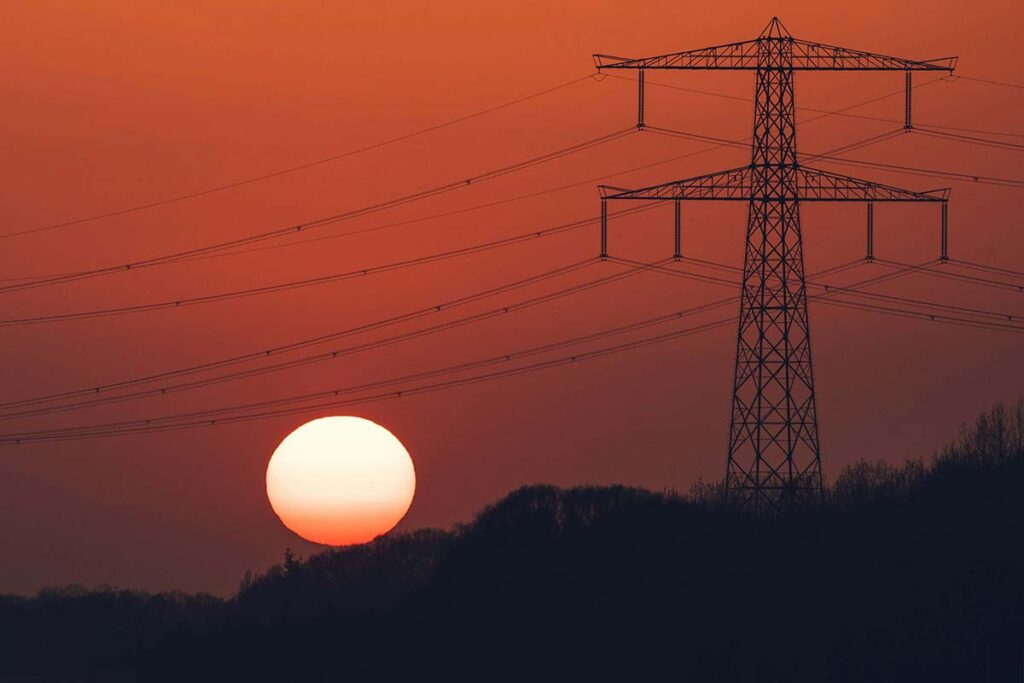
Your panels make the most power in the middle of the day. That’s usually when nobody’s home to use it.
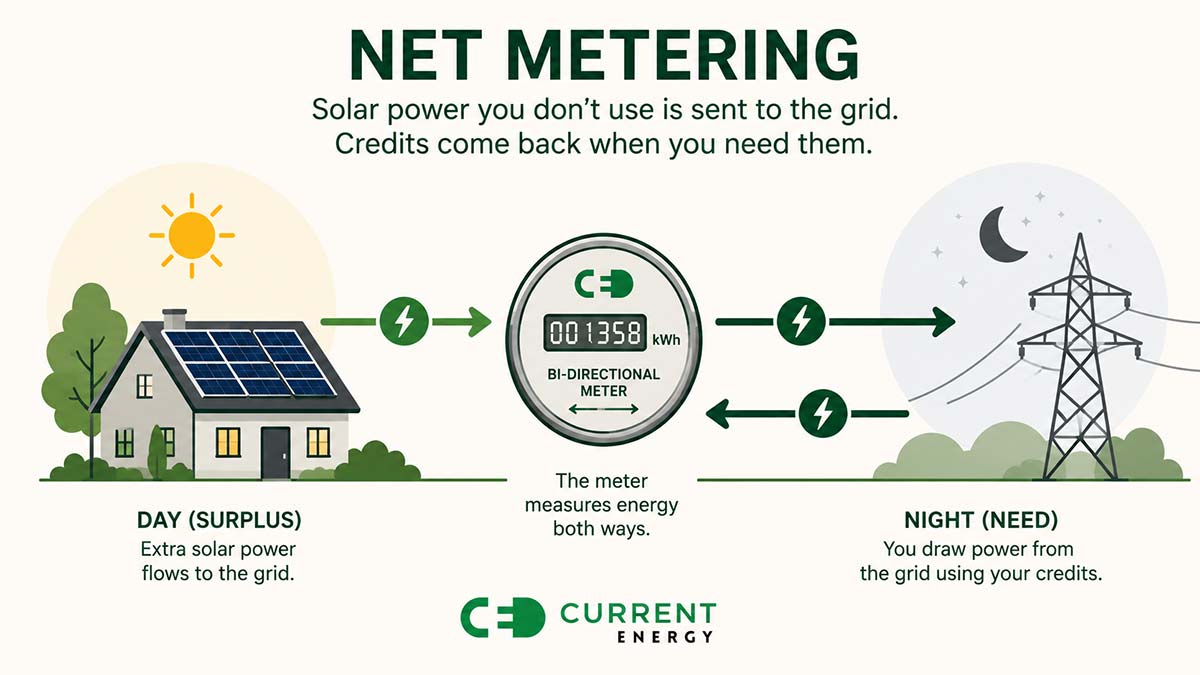
Net metering is what makes that extra power count. It goes out to the grid, and your utility credits it back to your account. Later, when the sun’s down and you’re pulling from the grid again, those credits cover it.
That’s the whole idea. The details are where it gets useful.
What Net Metering Is
Net metering is a billing arrangement. Your utility tracks the power you send to the grid against the power you pull from it, then bills you on the difference.
Make more than you use in a month, and the extra turns into a credit. Use more than you make, and the credits you banked earlier fill the gap.
How It Works, Step by Step
- Your panels produce power during the day.
- Your home uses what it needs first.
- Whatever’s left over flows to the grid, and your meter counts it.
- Your utility posts that exported power to your bill as a credit.
- At night, or on a gray February afternoon, you draw from the grid and the credits cover it.
The meter runs both directions. That’s really all net metering is doing.
Who Offers It Around Here
If your power comes from Eversource or National Grid, net metering is part of the deal. Unitil customers get it too. The state requires these utilities to offer it, and most of Western Mass falls under one of them.
There’s one exception worth knowing about. Some towns run their own municipal light plant instead of buying from a big utility. Those aren’t required to offer net metering, and the ones that do sometimes run it on their own terms. If your electric bill comes from the town, check what they offer before you count on it.
How Big a System Qualifies
Almost every home qualifies without any hassle.
The state exempts residential systems up to 25 kilowatts from the net metering cap. A normal house system runs well under that. The threshold used to be 10 kilowatts, which got tight for bigger homes or anyone planning to add an EV charger or a heat pump down the road. The higher limit gives you room to size the system for where your electric use is headed, not just where it sits today.
What Your Credits Are Worth
A net metering credit is worth close to what you’d pay for that same power. Not quite the full retail rate, but near it. In a state with some of the highest electric rates in the country, that’s a credit with real weight behind it.
Two things about how the credits behave.
They roll over month to month. Your summer surplus doesn’t vanish. It sits on your account and waits for winter.
Once a year, though, the utility cashes out whatever credits are left and pays a lower rate for those. So a system sized way past your actual use doesn’t do you much good. You want it matched to what your house pulls over a year. Some homeowners go a different route and pair solar with battery storage, keeping their own power on site instead of exporting it for a credit.
Net Metering and SMART Are Not the Same Thing
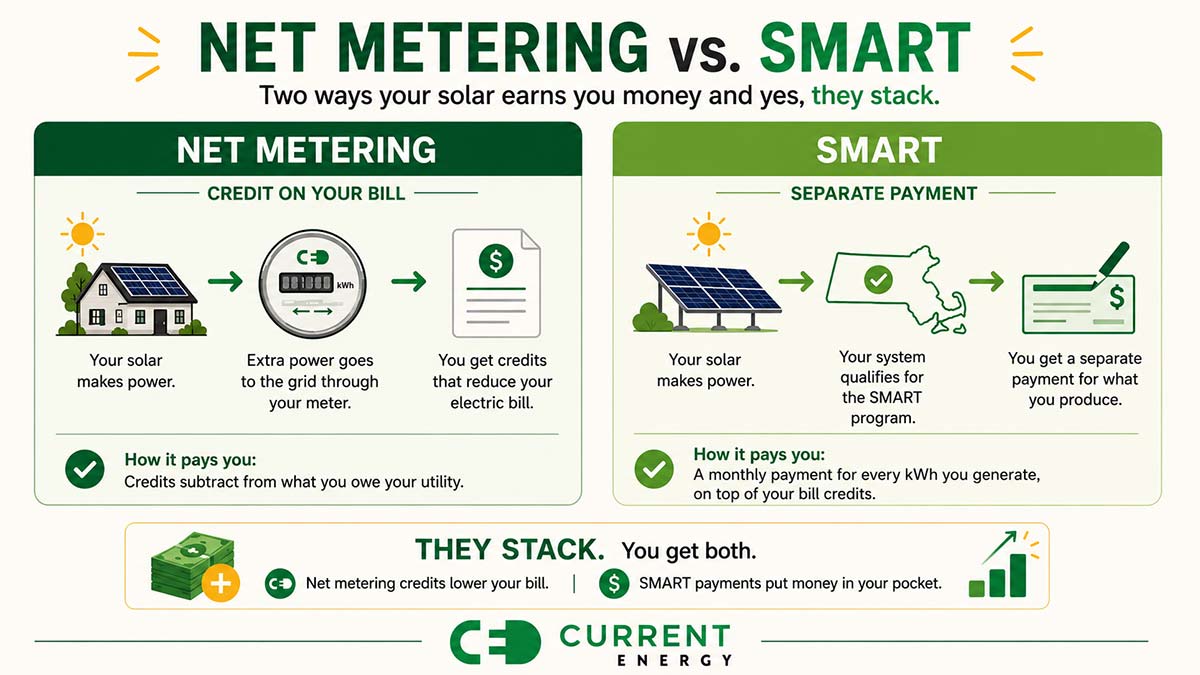
People mix these up all the time. They’re two separate things, and you get both.
Net metering credits the power you export. SMART pays you for the power you generate, all of it, whether you use it at home or send it out. One shows up as a credit on your bill. The other is a separate payment that runs for ten years.
They stack. Here’s the side by side.
| Net metering | SMART | |
|---|---|---|
| What it pays for | The extra power you send to the grid | Every kilowatt-hour your system produces |
| How it shows up | A credit on your electric bill | A separate payment |
| How long it lasts | Locked in for 25 years at hookup | A 10-year term |
| Can you get both? | Yes | Yes |
Net Metering Across a Western Mass Year
The calendar matters here more than it does in sunnier states.
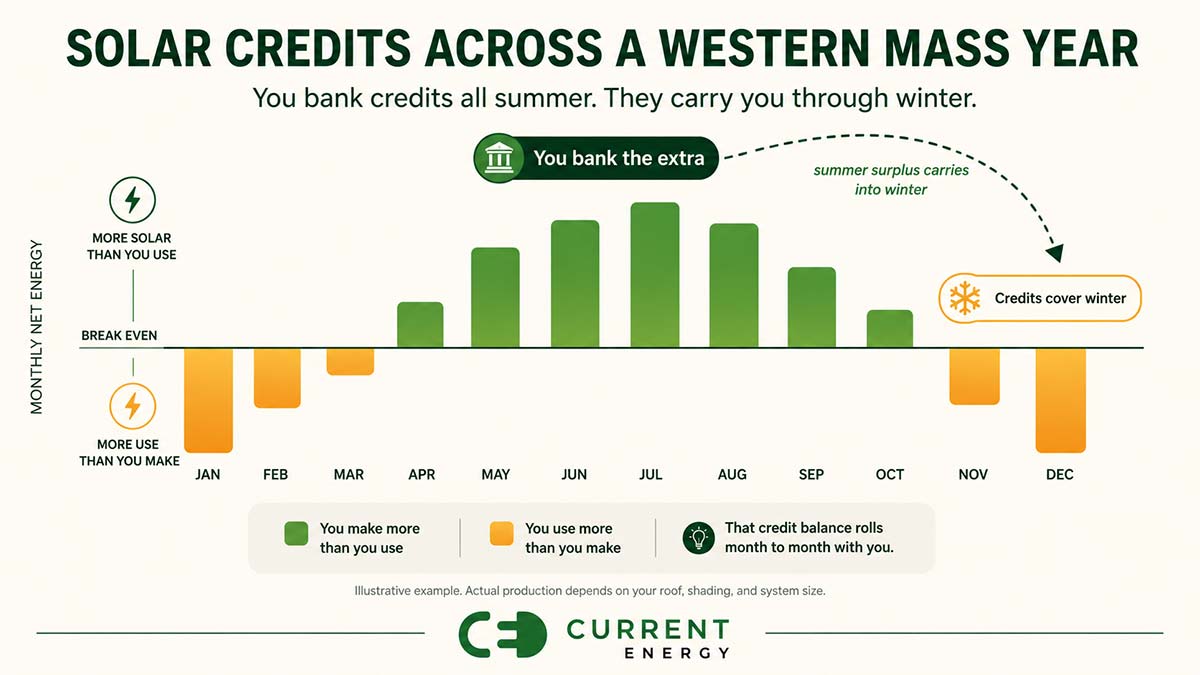
From April into October, a well-placed system usually makes more than the house uses. Those months build a cushion of credits. Then the short days show up. November through March, most homes use more than they produce, and a heat pump running through a cold snap only adds to it.
Net metering is what bridges that gap. The credits you bank over a Pioneer Valley summer are the ones carrying you through a Franklin County winter. It’s one system balanced across the whole year, not judged month by month.
What the DPU Review Means
You may have heard net metering is under review in Massachusetts. That part’s true. Here’s the straight version.
In December 2025, the state’s Department of Public Utilities opened a proceeding, docket 25-200, that looks at how electric rates are designed. Part of that review asks whether the value of net metering credits should come down. Other states have gone this way already. California cut its credit sharply. Illinois did too.
Now the part that matters for you. Nothing has changed yet. The near-retail credit and the 25 kW cap are both still in place today. And when Massachusetts has adjusted these rules in the past, it grandfathered the systems already connected. People who hooked up under the old terms kept them.
That’s why the timing is worth paying attention to. A system connected under today’s rules locks in today’s rules for 25 years. We’re not going to tell you the sky is falling. We’re telling you that the terms you sign up under are the terms you keep, and right now those terms are good.
Net Metering After the Federal Tax Credit
The 30% federal tax credit for home solar ended on December 31, 2025. Buy a system in 2026 with cash or a loan, and there’s no federal credit coming back to you. That was a big number, and it’s gone.
So the math leans harder on the pieces that are still here. Net metering is the main one. It’s the mechanism that turns your production into money off the bill, month after month, for decades. With the federal credit off the table, that bill savings is carrying more of the load than it did a year ago.
Massachusetts still has good net metering rules, and it still has SMART. That combination is a big part of why solar here keeps penciling out when it’s gotten harder in other states. If you want to see how the numbers work without the federal credit, our solar financing page walks through the options.
FAQ
Is net metering one-to-one in Massachusetts?
Close to it. You’re credited at near the retail rate for the power you export, not the full penny-for-penny amount, but near enough to matter. Massachusetts runs one of the better net metering setups in the country.
What size solar system qualifies?
Residential systems up to 25 kilowatts are cap-exempt, which covers just about every house. Larger systems can still net meter, though they may have to wait for cap room depending on the utility.
Do net metering credits expire?
They roll over month to month and don’t disappear during the year. Once a year the utility settles up any leftover credits at a lower rate, which is the reason sizing the system to your real usage pays off.
Is net metering going away in Massachusetts?
There’s a state review looking at credit values, opened in late 2025. Nothing has changed yet. Systems already connected have kept their terms through past rule changes, and current rules stay in effect until any new order takes hold.
What’s the difference between net metering and SMART?
Net metering credits the power you send to the grid. SMART pays you for everything your system produces, on a separate ten-year payment. You get both, and they stack.
Does net metering still work in winter?
Yes, and it’s built for exactly that. The credits you pile up over the summer are what cover the short, dark months. A clear February day still makes power, but net metering is what carries the heavier winter use.
Is solar still worth it now that the federal tax credit is gone?
For a lot of Western Mass homes, yes. The federal credit ending changed the math, but it didn’t erase it. Massachusetts has high electric rates, and net metering turns your production into real savings against them. SMART adds another stream on top. The honest answer depends on your specific roof and how much power you actually use, which is what a site review sorts out.
Thinking About Solar in Western Mass?
Net metering is one piece of a bigger picture. How your credits actually play out depends on your house. Your roof and how it faces the sun. How much power you use over a year. Which utility sends your bill.
Current Energy is based in Bernardston, and we work these towns every day across the Pioneer Valley and the hilltowns around it. We can look at your property and tell you what your production and your credits would really come to, in plain numbers, before you commit to anything.
Request a quote or give us a call. We’ll walk you through it.