
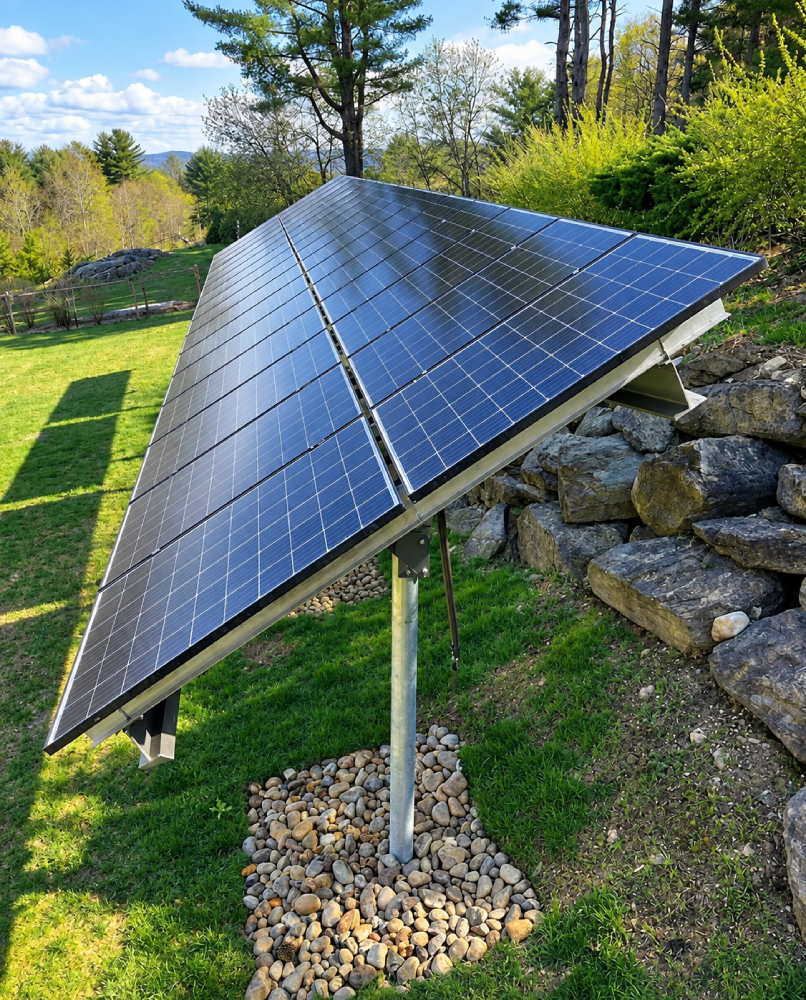
Ground-Mount Solar
Sometimes the Best Place for Solar Isn't Your Roof
If your roof is shaded, facing the wrong direction, getting close to replacement, or simply doesn’t have enough usable space, that doesn’t necessarily mean your property isn’t right for solar.
A ground-mounted solar system gives us another option. Instead of designing around the limitations of the roof, we can look for a sunnier part of the property and design the array around the available space, your energy needs, and the site itself.
For homeowners with enough open land, ground-mount solar can be an especially good fit for the rural and wooded properties we see throughout Western Massachusetts, southern Vermont, and southwestern New Hampshire.
Your Roof Isn't the Only Option
Solar panels don’t have to go on the house.
Sometimes moving the array to the ground gives us better sunlight, more room to work with, and fewer compromises.
When Is Ground-Mount Solar a Better Choice?
Rooftop solar makes a lot of sense when the roof has good sun exposure, enough usable space, and plenty of life left in it. But not every house gives us that combination.
That’s particularly true in this part of New England.
When the Roof Is Too Shaded
Trees are part of what makes Western Massachusetts and the surrounding region beautiful. They can also make rooftop solar difficult.
Sometimes selective tree work can improve a solar site. Other times, the better answer is to leave the roof alone and move the panels to an open part of the property.
A ground mount gives us more freedom to choose a location based on where the sun is rather than where the house happens to be.
When the Roof Isn't Ideal for Solar
A roof can be perfectly good at being a roof and still not be a great place for solar.
The orientation may be wrong. Dormers, chimneys, additions, and multiple rooflines may break the available area into small sections. An older roof may also be approaching replacement, making it worth considering whether the panels belong there in the first place.
Ground mount can remove many of those constraints.
For homeowners with older houses, there can be other considerations as well. Solar for Older Homes looks more closely at how roof condition, structure, electrical systems, and future energy needs fit into the decision.
When You Have Better Solar Somewhere Else
On a rural property, the best solar resource may be 50, 100, or several hundred feet away from the house.
If there’s an open field, clearing, or sunny section of the yard, we can evaluate it alongside the roof rather than assuming rooftop solar is the only choice.
Ground-mounted panels can also be positioned and angled for good solar exposure instead of having their orientation dictated by the house.
Ground Mounts Make Sense in This Part of New England
Western Massachusetts isn’t a landscape of wide-open suburban lots. We have wooded properties, hillsides, old farmhouses, barns, long driveways, stone walls, rocky ground, and houses that weren’t built with solar panels in mind.
That can make finding the right place for solar more interesting.
A good ground-mount design has to consider more than where there’s an empty patch of grass. We need to think about year-round shade, the slope and condition of the land, snow, access to the array, the distance back to the electrical system, and how the installation will fit into the property once it’s there.
Sometimes the roof is the obvious choice. Sometimes the ground is.
The important part is figuring that out before designing the system.
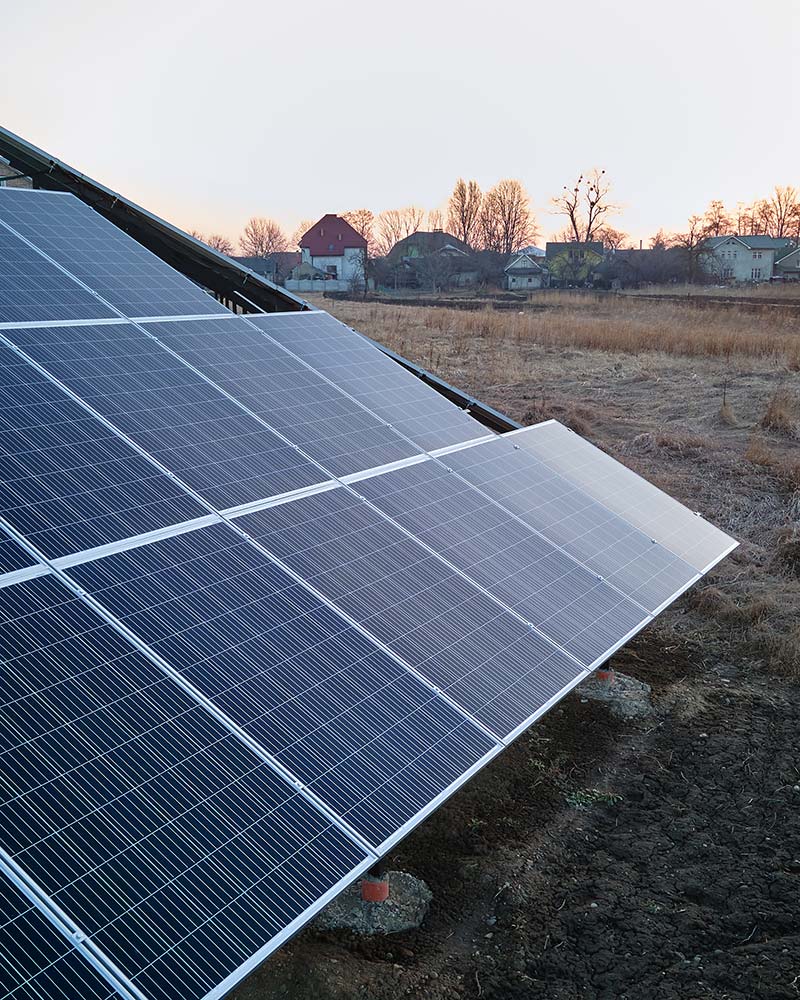
Sometimes the Best Solution Uses More Than One Structure
A traditional ground mount isn’t the only alternative when the roof doesn’t have enough usable space.
A detached garage, barn, carport, or other structure may offer good solar exposure. And sometimes it makes sense to use more than one location, with panels divided between the house and another structure on the property.
The goal isn’t to put every panel in the same place. It’s to make the best use of the property you have.
What Goes Into a Ground-Mount Solar Installation?
A ground mount gives us more flexibility than a roof, but it also introduces a different set of design decisions.
Start With Sunlight and Site Conditions
The first question is whether the proposed location has good solar exposure throughout the year.
From there, we look at the usable space, slope, surrounding trees, access, and the ground itself. Rocky soil and ledge can affect how a ground-mounted system is built, just as the structure and condition of a roof affect rooftop solar.
The goal isn’t simply to find somewhere the panels will fit. It’s to find a location that works as part of the complete system.
Distance From the House Matters
A ground-mounted array still needs to connect back to your home’s electrical system.
That means the distance between the array and the house matters. Longer runs can mean more trenching, conduit, wiring, and electrical design considerations. Driveways, ledge, landscaping, and other obstacles can also affect the route.
This is one reason it’s worth thinking about the solar array and the home’s electrical system together rather than treating them as two separate projects.
Ground Mounts Still Need Local Approval
Where you can place a ground-mounted solar array depends in part on where you live.
Setbacks, zoning requirements, screening, and other local rules can affect the available location. The permitting process also differs across our service area. Massachusetts and New Hampshire rely heavily on local permitting, while grid-connected solar projects in Vermont have an additional state approval process.
We account for those requirements as part of planning the project rather than assuming that every open piece of land is automatically buildable.
Think About the Property After Installation
A ground-mounted array becomes part of the landscape, so it’s worth thinking about what happens around it.
You’ll still need access to the area. Grass and vegetation need to be managed. Snow can accumulate around the lower edge of an array, although having the panels at ground level makes them considerably easier to reach than panels on a roof.
Placement also affects what you’ll see from the house, driveway, road, and neighboring properties.
These aren’t reasons not to choose a ground mount. They’re reasons to choose the location thoughtfully.
Ground Mount vs. Rooftop Solar
Neither option is automatically better.
A good rooftop installation uses space that’s already there and generally requires less additional infrastructure. If your roof has good solar exposure, enough usable area, and plenty of life left, putting panels on it may be the simplest solution.
Ground mount usually costs more because we’re building a structure specifically for the array and connecting it back to the house. In exchange, it gives us much more control over where the panels go and how they’re oriented.
It can also keep solar off an aging or complicated roof and eliminate the need to remove and reinstall those panels when that roof eventually needs replacement.
The right answer comes down to the property.
Frequently Asked Questions About Ground-Mount Solar
Is ground-mount solar more expensive than rooftop solar?
Usually. A ground-mounted system requires its own support structure as well as the electrical connection between the array and the house. Site preparation and trenching can add to the project as well.
How much more depends heavily on the property, which is why a generic price-per-panel comparison doesn’t tell you very much.
How much land do I need for ground-mounted solar?
It depends on the size of the system and the usable area around it.
The panels themselves are only part of the footprint. We also have to consider spacing, shade from nearby trees or structures, setbacks, access, and the shape and slope of the available land.
You don’t necessarily need a huge field, but you do need enough open space in the right place.
Does a ground mount produce more electricity than rooftop solar?
It can, particularly when we’re comparing it with a roof that has poor orientation or significant shade.
Because a ground mount isn’t tied to the direction or pitch of the roof, there’s more flexibility in how the panels are positioned. If you already have an excellent solar roof, however, the production difference may be much smaller.
How far can solar panels be from my house?
There isn’t one distance that works for every property.
Ground-mounted arrays can be located away from the house, but the electrical run becomes an increasingly important part of the design as that distance grows. The route between the array and the electrical system matters too.
We’ll consider both the solar exposure and what it takes to connect that location back to the house.
What happens to a ground mount in the snow?
Ground-mounted solar is designed for outdoor conditions, including New England winters.
The angle and clearance of the array are important considerations in snowy climates. Snow can slide from the panels and accumulate below them, so the system needs to be planned with winter conditions in mind.
One practical advantage is accessibility. If snow does need attention, a ground-mounted array is much easier to reach than panels on a roof.
Do ground-mounted solar panels require more maintenance?
Not necessarily, although the area around the array does need some attention.
Vegetation needs to be kept from growing up around the panels, and the site should remain accessible. Being at ground level also makes it easier to inspect the system and reach the panels when necessary.
Can I add a battery to a ground-mounted solar system?
Yes. The solar panels don’t have to be on the roof to work with battery storage.
For rural properties in particular, solar and battery storage can be worth considering together when backup power and outage resilience are part of the goal.
Learn more about Battery Storage & Backup.
What if I have enough room for solar on both my house and elsewhere on the property?
Solar doesn’t necessarily have to be an either-or decision between the house and the ground.
Depending on the property and the amount of electricity you’re trying to produce, a system can sometimes use more than one suitable location. The important thing is designing those pieces as one electrical and energy system.
Finding the Right Spot Is Only the Beginning
Once we’ve identified a good solar location, the rest of the property still matters.
Ground conditions, distance, electrical design, zoning, and access all become part of the project.
Is the Ground a Better Place for Your Solar?
You don’t have to decide whether you need rooftop or ground-mounted solar before you call us.
We’ll look at the house, the property, your energy use, and the available sunlight and help you understand which approach makes the most sense.
Sometimes that’s the roof. Sometimes it’s somewhere else on the property.
"*" indicates required fields