
Battery Storage & Backup
Backup Power Designed Around Your Home
A home battery can keep the lights on when the grid goes down. But designing a good backup system starts with a more useful question: what does your home need during an outage?
For a homeowner in Western Massachusetts, that might include the refrigerator, well pump, heating equipment, lights, internet, and other essentials. On a rural property, losing electricity can also mean losing water or other systems you depend on every day.
Current Energy designs battery storage and backup systems for homes throughout Western Massachusetts, southern Vermont, and southwestern New Hampshire. We look at your solar, electrical system, backup priorities, and energy use together rather than treating the battery as a standalone piece of equipment.
It's Not Just About the Size of the Battery
More battery capacity can provide more backup power. But that’s only one part of the equation.
What you choose to power matters just as much.
What Do You Want to Keep Running?
When the power goes out, most homes don’t need every electrical load running at once.
You probably care a lot about the refrigerator and freezer. If you’re on a well, the well pump quickly moves up the list. Heating equipment, internet, lighting, medical equipment, sump pumps, and other essentials may matter too.
Those aren’t hypothetical concerns in Western Massachusetts. Many of the homes we work with are outside dense town centers, where wells are common and an outage can affect several basic household systems at once.
Large electrical loads change the picture considerably.
That’s why battery planning starts with the home and the people living in it, not simply a battery capacity printed on a specification sheet.
Whole-Home Backup Doesn't Mean Everything Runs at Once
A battery system can be designed to back up a home’s electrical system while still managing which circuits receive power during an outage.
That’s where load management becomes particularly useful.
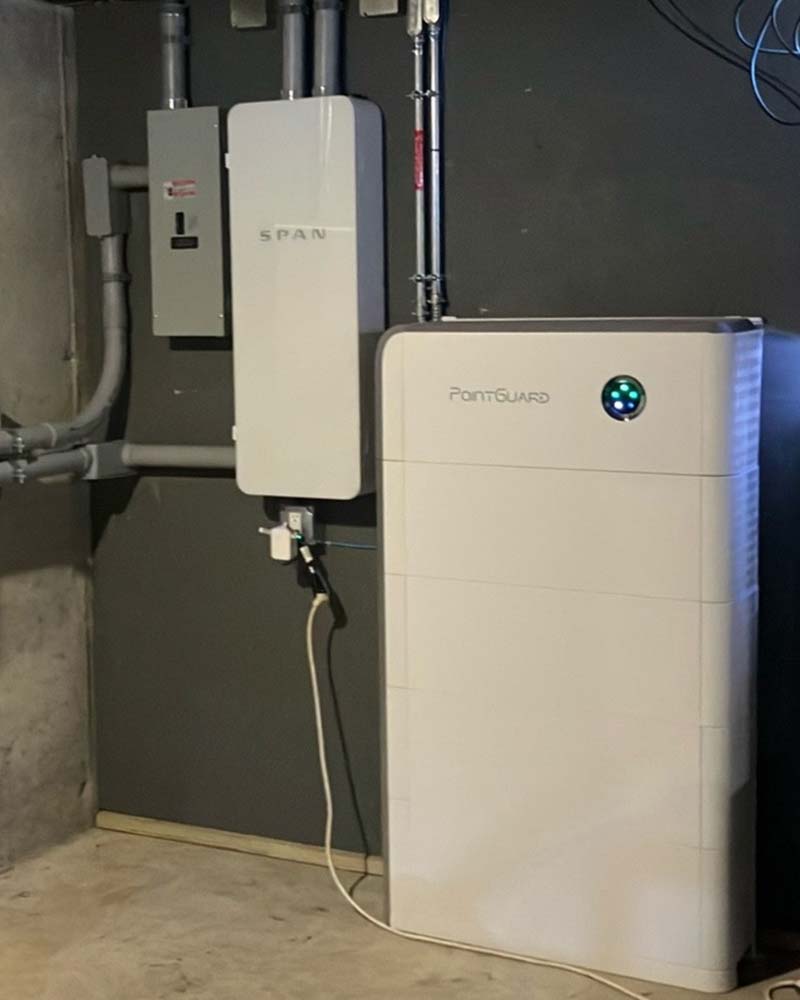
Current Energy works with Span smart electrical panels, which provide circuit-level monitoring and control. During an outage, loads can be prioritized so essential circuits continue operating while less important loads are turned off. Those priorities can be changed rather than being permanently assigned to a traditional critical-loads panel.
That gives us another way to think about backup duration: not just how much energy we can store, but how intelligently we use it.
Solar and Battery Work Together, But They Do Different Jobs
Solar becomes part of your home’s electrical system, so the existing service and panel need to be part of the conversation.
Some homes are ready for solar as they are. Others may need electrical work or a service upgrade before or as part of the installation. Every home solar installation starts with a different combination of energy use, roof conditions, shade, and electrical capacity.
This is particularly relevant in a region with so many older homes. Western Massachusetts has a substantial stock of older houses, farmhouses, and homes that have been expanded or altered over time. Older electrical services and panels may need additional attention when planning a solar installation.
When an Outage Means More Than Losing the Lights
A winter storm, heavy wet snow, wind, or a downed tree can interrupt power anywhere. But an outage on a rural Western Massachusetts property can have consequences that aren’t always obvious until the electricity is gone.
If you’re on a well, no power can mean no water. Heating systems may depend on electrical controls, pumps, or blowers even when electricity isn’t the primary heat source. Refrigerators, freezers, sump pumps, internet equipment, and other basics still need power.
Homes here can also present very different electrical starting points. Older houses may have older panels or electrical services, while renovated homes may now be supporting heat pumps, EV charging, and other loads that weren’t part of the original electrical system.
Battery backup has to be designed around that reality.
The goal isn’t necessarily to keep every electrical load running as though nothing happened. It’s to decide what matters most and build a system that uses the available stored energy wisely.
Battery Storage With New Solar
If you’re installing solar and battery storage together, we can plan them as one system from the beginning.
Current Energy uses a DC-coupled approach with SolarEdge equipment for new solar-and-storage installations. With DC coupling, solar energy can move into battery storage without first being converted to AC electricity and then converted back again for storage.
For the homeowner, the important part isn’t the terminology. It’s that the solar, storage, backup equipment, and home’s electrical needs can all be considered together from the beginning.
Already Have Solar? You Can Still Add Battery Backup
A lot of homes in Western Massachusetts already have solar, including systems installed years before residential battery storage became as common as it is today.
That doesn’t necessarily mean starting over.
For retrofits, Current Energy uses FranklinWH battery storage, an AC-coupled system designed to work with existing solar equipment and a wide range of inverter brands.
So if your solar is working well but you now want backup power, we can evaluate the existing system and determine how storage can fit into it.
The Electrical Panel Is Part of the System
This becomes especially important in the older housing stock we see throughout Western Massachusetts and southern New England.
Some homes still have older electrical services and panels. Others have been updated over time and are now adding substantial new loads such as heat pumps, induction cooking, EV charging, or additional living space.
Battery storage changes the way electricity moves through the house during an outage, so the panel, available service capacity, larger loads, backup equipment, solar system, and battery all need to work together.
A smart electrical panel such as Span can add another level of control by monitoring individual circuits and managing which loads operate during backup.
This is one reason Current Energy approaches battery storage as both a solar and electrical project.
Where the Battery Goes Matters in a New England Winter
Battery storage equipment needs an appropriate location, and our climate is part of that decision.
A basement, conditioned utility space, garage, or approved exterior location can present very different temperature conditions in January. Equipment specifications, electrical access, clearances, and the particular house all affect where a battery should go.
We consider those conditions when designing the system rather than treating battery placement as an afterthought.
Battery Programs Depend on Where You Live
Current Energy works across three states, and battery economics aren’t identical across them.
A homeowner in Western Massachusetts may have Eversource, National Grid, or a municipal light plant. Southern Vermont has a different utility landscape, including Green Mountain Power and its battery programs. Southwestern New Hampshire has its own utilities and program structures.
That can affect what programs are available and how a battery can participate in them.
We don’t assume that an incentive or utility program available to one homeowner applies to the next. Your address and utility are part of the battery conversation.
Frequently Asked Questions About Home Battery Storage
How long will a home battery last during an outage?
It depends primarily on how much battery capacity you have and what you’re powering.
A refrigerator, well pump, lights, internet, and a few essential circuits use far less electricity than trying to operate every load in the house normally.
That’s why we look at backup priorities when designing the system. Managing loads can make the available stored energy last longer.
Can a battery back up my entire house?
A battery system can be configured for whole-home backup, but that doesn’t necessarily mean every appliance should run simultaneously during an outage.
Large loads require more power and consume stored energy more quickly. Load management allows the system to prioritize what’s important and reduce or shut off less essential circuits when necessary.
Can I add a battery if I already have solar?
Yes. Battery storage can be added to many existing solar systems.
This is particularly relevant for homeowners who installed solar years ago and are now interested in outage protection. Current Energy uses an AC-coupled approach for these retrofits so storage can work alongside existing solar equipment.
Do I need solar panels to have a home battery?
Not necessarily. A battery can be charged from the grid, depending on the system and utility configuration.
Solar changes the equation because it can provide a source of energy for recharging the battery when the grid is unavailable.
Will my solar panels work when the power goes out?
A standard grid-connected solar system typically shuts down during a utility outage for safety.
Solar paired with properly configured battery storage and backup equipment can continue supplying the home’s backed-up electrical system while remaining safely isolated from the grid.
Can a battery run my well pump?
Potentially, yes, but the pump needs to be considered when the backup system is designed.
That’s an important question in Western Massachusetts, southern Vermont, and southwestern New Hampshire, where many homes rely on private wells. Pumps can have substantial starting loads, so we don’t want to discover after an outage that the system wasn’t designed around one of the home’s essential needs.
What about an EV charger or heat pump during an outage?
These are larger electrical loads and need to be considered individually.
You may decide they’re important enough to support, or you may choose to prioritize other circuits so your stored energy lasts longer. Smart load management provides more flexibility in making those decisions.
Are there incentives for home batteries in Massachusetts, Vermont, and New Hampshire?
Potentially, but what’s available depends on the state, utility, equipment, and current program rules.
The three states don’t have identical battery programs, and even two Western Massachusetts homeowners can have different options if one is served by an investor-owned utility and the other by a municipal light plant.
We’ll look at the programs that apply to your location rather than assuming a statewide incentive applies to everyone.
The Right Battery System Depends on More Than the Battery
A new solar installation and an existing solar system present different opportunities.
So do an older farmhouse, a newer all-electric home, and a house that’s gradually adding heat pumps and EV charging.
What Would You Want Running When the Power Goes Out?
That’s where we start.
We’ll look at your home’s electrical system, your solar if you have it, the loads you want to protect, and how you use electricity. Then we can design battery storage and backup around the things that matter when the grid isn’t there.
Current Energy serves homeowners throughout Western Massachusetts, southern Vermont, and southwestern New Hampshire from our home base in Bernardston, Massachusetts.
"*" indicates required fields