
When we talk about Bernardston commercial solar, we’re not talking about a far‑off market. This is home. Our shop, our crews, and a lot of our early projects are rooted right here in Bernardston and the nearby Franklin County towns. We’ve watched how solar shows up on real bills for local businesses and farms that live with some of the highest commercial electric rates in the continental US.
We’re Current Energy, based on South Street in Bernardston. What we’ve seen here shapes how we think about commercial solar across Western Massachusetts.
Why Bernardston is a good test case for commercial solar
Bernardston sits in a stretch of Western Massachusetts where:
- Commercial electric rates commonly land in the 0.22–0.30 per kWh range, well above many other parts of the country.
- Businesses and farms often run a mix of electric loads, lighting, refrigeration, pumps, office, shops, on top of fuel‑driven equipment.
- State programs like SMART and strong net metering rules still reward on‑site generation for commercial systems.
That combination makes every kilowatt‑hour you avoid buying from the grid more valuable. A kilowatt‑hour of solar production at a Bernardston business is offsetting some of the most expensive commercial power in the lower 48.
We’ve also watched large community and commercial solar projects in Franklin County, including a Bernardston community solar project under the SMART program, show that well‑designed systems can deliver millions of kilowatt‑hours and long‑term savings for subscribers and operators. It’s a reminder that this region is already leaning hard on solar, not as a stunt, but as a tool.
What real‑world savings look like for Bernardston businesses
The exact numbers change from roof to roof, but the pattern is consistent.
For a typical Bernardston commercial customer:
- A properly sized system trims a meaningful slice of annual kWh usage, often covering a large share of daytime load.
- That production offsets power at roughly 0.22–0.30 per kWh, so each kilowatt‑hour produced carries significant value.
- With today’s incentives, many commercial projects can see a simple payback in the high‑single to low‑double‑digit years, depending on load profile, roof or ground conditions, and how aggressively incentives and depreciation are used.
For businesses with steady daytime use—manufacturing, trades, offices, retail, small warehouses—the alignment between solar production and demand is especially strong. For farms and more seasonal operations, the picture still works; it just needs to be modeled around their specific patterns.
We’ve seen solar bills and utility bills side by side for Bernardston customers over multiple years. The story isn’t “magically free power.” It’s “a large, noisy line item that stops growing as fast and becomes more predictable.”
Incentives Bernardston commercial systems still tap in 2026
Unlike the residential side, commercial solar has kept its main federal support for new projects.
A Bernardston commercial solar project in 2026 can typically use:
- Federal commercial ITC (Section 48/48E):
A base 30% investment tax credit remains available for qualifying commercial systems, with the potential for bonus adders in some circumstances. - MACRS + bonus depreciation:
Systems can be depreciated over five years, with an additional 20% first‑year bonus depreciation in 2026. That puts a big chunk of the system cost into tax deductions early. - Massachusetts SMART program (commercial tiers):
SMART 3.0 and subsequent program blocks continue to pay performance‑based incentives for solar generation, including projects serving low‑income or community solar subscribers. - Property and sales tax exemptions:
Solar equipment remains exempt from Massachusetts sales tax and enjoys favorable property tax treatment under state law.
Put together, those incentives don’t make Bernardston commercial solar trivial. They do explain why, even in a small town, it can be a rational investment instead of just a marketing line.
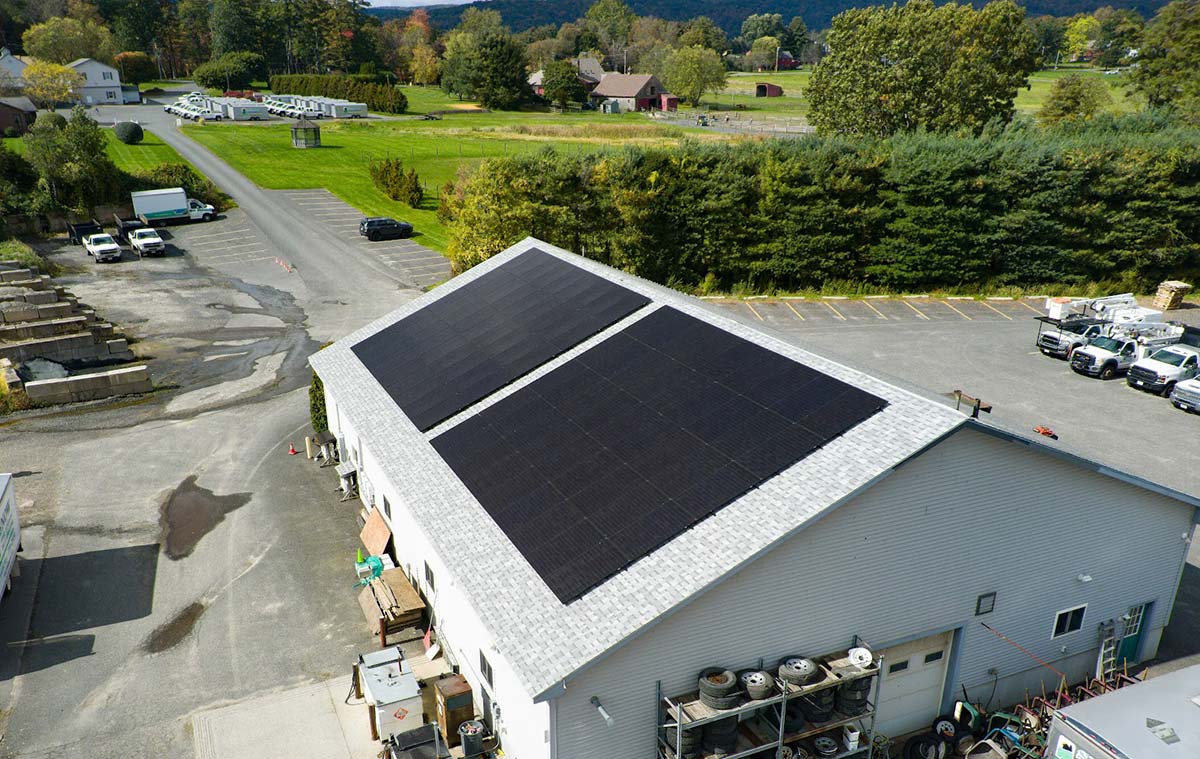
How we see Bernardston roofs and land differently
Because we live and work here, we don’t look at Bernardston buildings like generic commercial squares on a Google map. We see:
- Older low‑slope roofs on Route 5 and side roads, some ready for solar, some asking for roof work first.
- Barns and shops with fields or open land nearby where ground‑mounted arrays could do better work than a tired roof.
- Mixed‑use buildings and small commercial properties that rely on predictable bills to keep tight margins under control.
In practice, that leads us to:
- Say “roof now, maybe ground later” when a strong roof and open land both exist.
- Say “ground first” when the roof isn’t a safe or sensible host.
- Say “not yet” when the building or ownership situation would make a long‑lived solar asset a burden instead of a help.
We’re not guessing. We’re driving past these roofs every day and talking to the people paying the bills under them.
Fuel costs, farms, and why timing matters here
Bernardston and the towns around it run on a mix of grid power and fuel. Rising gas and diesel prices hit deliveries, equipment, and the general cost of doing business. For farms, higher fuel prices have also been pushing fertilizer and other inputs up, adding pressure on top of already thin margins.
Solar doesn’t change diesel prices or fertilizer markets. It does let a Bernardston operation:
- Lock in a portion of its electric supply at a time when commercial kWh prices are high and volatile.
- Use under‑utilized roof or land to generate something that offsets other rising costs.
- Pair solar with future electrification—more electric equipment, heat pumps, or EVs—so those loads aren’t fully exposed to whatever the grid charges next.
That’s why we’re seeing more local interest now, even with residential incentives shifting. For commercial and farm customers, the case has as much to do with control as it does with “going green.”
What Bernardston business owners should ask before moving ahead
Being our home base doesn’t mean we assume every project is a yes. The Bernardston businesses that end up happiest with solar usually ask:
- How does this design line up with our load profile, not just our roof size?
- How are you modeling the ITC, SMART, and depreciation for our specific situation?
- What’s your honest read on our roof or ground conditions, and what work needs to happen before or alongside solar?
- If we expand operations or add EVs and new equipment later, does this system leave room for that?
Good answers should feel local: tied to Bernardston rates, Bernardston building stock, and Bernardston grid conditions—not to a generic picture of “a business somewhere in Massachusetts.”
Bernardston commercial solar isn’t an abstract case study for us. It’s what happens when businesses and farms in our own town decide to turn their roofs or land into part of their energy plan. Our role is simple: read the building and the incentives honestly, show what the real‑world savings can look like over time, and only build systems that make sense for the people who have to live with them every month when the bill arrives.