

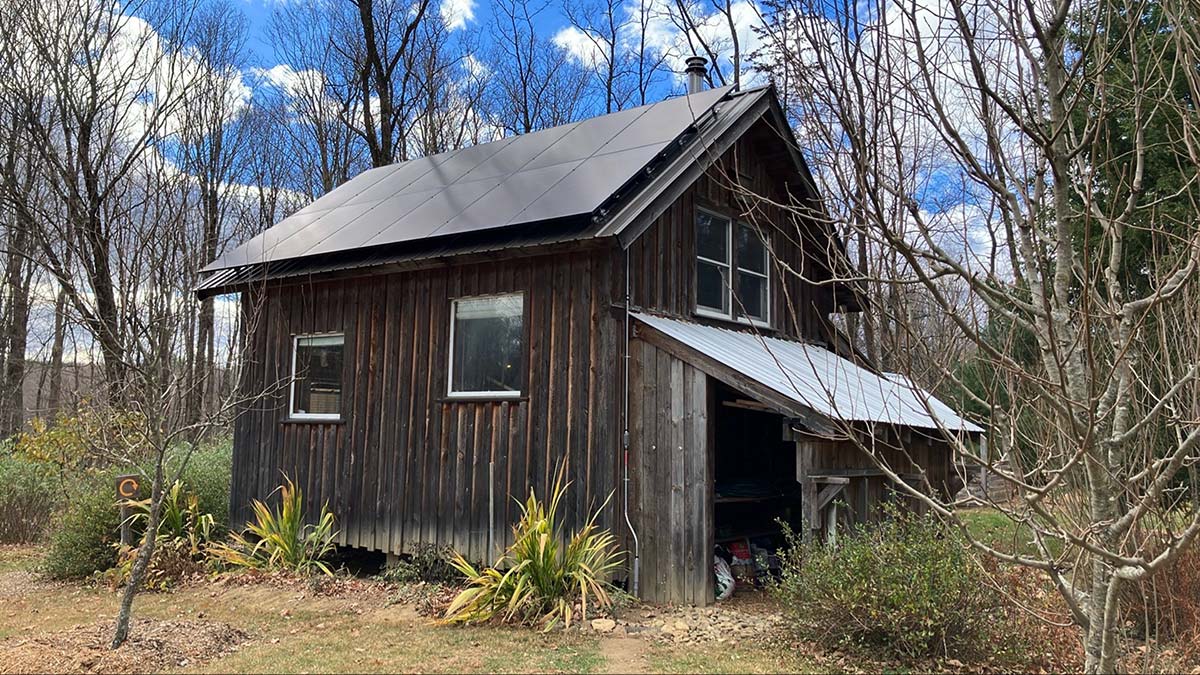
If you live in Shelburne, your house probably doesn’t sit on a flat, perfect lot. Rooflines lean into the hill. Driveways twist. Trees and stone walls mark out old property lines. Shelburne residential solar installation has to work with that kind of terrain, not against it. The good news is that hillside roofs and open land can be assets, not obstacles, if we design around them on purpose.
We’re Current Energy. We spend a lot of time on roofs and properties from Greenfield west, including Shelburne. When we look at your place, we’re asking one big question: where does the sun naturally fall on this house and this land, and how do we match the solar system to that?
Hillside roofs: how slope and direction can help you
A lot of Shelburne homes sit on slopes. That means one side of the roof may rise into the sky while the other tucks into the hill or looks into the trees.
We pay attention to:
- Which roof planes “see” the valley and the open sky.
- How the hill shapes sunrise and sunset—where light first hits and where it lingers.
- How snow and rain already move off the roof.
A hillside home might have one roof face that’s almost ideal for solar—good tilt, long exposure—while the other spends half the day in shade. In those cases, we don’t try to force panels onto every plane. We pick the one that lines up best with the sun and build the system around that surface.
Sometimes the hill does half the work for us by giving that good roof plane a little extra tilt toward the sky. That’s the kind of “problem” we’re happy to have.
When the roof isn’t enough: using open land as your second option
Shelburne also has something a lot of more crowded towns don’t: open land. Field edges, old pasture, unused corners of yard, land just above or below the house on the slope—all of those can be candidates for a ground‑mounted array.
We look for:
- A patch of land with steady sun, not tucked under a ridge or tree line.
- Reasonable access for installation and maintenance—no need to haul steel through a ravine.
- A clear path for conduit to reach your electrical service without tearing the property apart.
If the best sun on your property hits the hillside just above the house rather than the roof itself, ground‑mounted solar starts to make sense. For some Shelburne homes, the right answer ends up being a modest roof array plus a small ground mount where the hill catches light all day.
You’re already working with the slope when you mow, plow, or walk the land. We’re just asking whether part of that hillside can quietly pull its weight as a power plant.
Balancing views, neighbors, and how the property feels
One thing Shelburne homeowners care about—often deeply—is how the place looks and feels. Views over the Deerfield River valley, a tree line you love, the way the house sits in the landscape: none of that is trivial.
When we talk about roof and ground options, we’re also talking about:
- Which roof planes are visible from the road and which are mostly seen by you.
- Where a ground mount would sit relative to your primary views out of the house.
- How any new structure fits with existing stone walls, fences, driveways, and fields.
Sometimes the most efficient spot for solar is not the spot that feels right. In that case, we’ll show you both options—the “best yield” location and the “best fit” location—and let you weigh the tradeoff. A slightly smaller or differently placed array that you’re happy to look at every day is often better than a bigger one you regret.
Roof, land, and bills: how we tie it all together
Designing Shelburne residential solar installation isn’t just a map of panels. It’s a map of your life on this property.
We start with:
- Your actual electric bills over a year or two.
- How you use power now and what’s coming—heat pumps, EVs, shop tools, home office.
- How long you plan to stay in the house and what you might change about it.
Then we match that to:
- The roof planes that really see the sun.
- The parts of the hillside or yard that could host a ground mount without ruining what you love about the place.
- Any roof work or electrical upgrades that should be paired with solar instead of ignored.
The result might be a roof‑only system on a good hillside plane, a ground‑only system on a sunny terrace, or a combination. The point isn’t to squeeze panels into every possible spot. It’s to choose the spots that make sense for both your bills and your daily view out the window.
When Shelburne residential solar installation is a good fit
On paper, almost any house can be given a panel count. In real life, we’re looking for signs that installing solar on your Shelburne property will feel like a solid long‑term move, not an experiment.
You’re usually in that zone if:
- At least one roof plane or hillside gets a clean shot of sun.
- Roof condition isn’t hanging by a thread.
- There’s open land you’d be comfortable dedicating to panels if the roof alone doesn’t cut it.
- Your electric bills feel high enough that trimming them matters, and you expect to be in the house for the next stretch of years.
If that sounds like you, Shelburne residential solar installation becomes less about fighting the hill and more about letting the hill help. Our job is to read your roof and land honestly, show you where solar would actually work, and then design a system that fits the way you already live on that slope.