
Table of Contents
ToggleDo You Need an Electrical Panel Upgrade for Solar?
You’re ready to put solar on the house. Then somebody takes a look at the electrical panel and starts talking about an upgrade.
That can sound like an automatic extra expense. It isn’t.
Some homes do need electrical work before solar goes in. Plenty don’t. And when work is needed, “panel upgrade” can mean a few different things. Replacing an old panel is one job. Increasing the electrical service from 100 amps to 200 amps is another.
Around Western Massachusetts, this comes up a lot. We have old houses, houses that have been added onto more than once, and electrical systems that have changed a piece at a time over the years. The number stamped on the main breaker only tells part of the story.
Why does the electrical panel matter for solar?
Think of the panel as the point where the house’s electrical circuits come together. With solar, you’re adding another source of electricity to the system.
So before designing the array, someone needs to look at what’s already there. What is the panel rated for? What is the busbar rated for? Is there room for the solar connection? Is the equipment in good shape?
Sometimes the answer is simple. Sometimes an older house has a few surprises waiting behind the panel cover.
Does solar mean you need 200-amp service?
No.
There’s no blanket rule that says a house needs 200-amp service before it can have solar. A 100-amp home may be perfectly workable. And a 200-amp panel doesn’t guarantee that every solar design can simply be connected to it.
This is where the details start to matter.
The main breaker has a rating. So does the busbar inside the panel. Then there’s the output from the solar equipment. Electrical code sets limits on how those pieces can work together.
You may run across the “120% rule” while researching solar. One common example uses a 200-amp busbar and a 200-amp main breaker, which can allow a 40-amp solar breaker under that particular calculation.
Useful to know? Sure. But it’s not something a homeowner should have to solve at the kitchen table. The electrician designing the connection needs to work from the actual equipment in the house and the code that applies to the project.
Can you install solar with a 100-amp panel?
Sometimes.
“You have 100 amps, so you need 200” is one of those answers that sounds wonderfully simple until you look at the house.
A 100-amp panel can put limits on a conventional solar connection. That doesn’t necessarily mean the next step is a 200-amp service. Depending on the equipment and the solar design, there may be another code-compliant way to connect the system. Other times, replacing the panel or increasing the service really is the sensible way to go.
There’s another wrinkle here. A panel can be physically full without the house being out of electrical capacity. The reverse can happen too. A few open breaker spaces don’t tell you how much additional load the service can handle.
So we wouldn’t make this decision from a photograph of the breaker panel and the number on the main breaker. You have to look at the system.
A new panel and a service upgrade aren’t the same job
“Panel upgrade” gets used pretty loosely.
Say you have an old panel that needs to be replaced. An electrician may be able to install new equipment and keep the same service size. That’s a panel replacement, but it doesn’t necessarily turn a 100-amp service into a 200-amp service.
A true service upgrade goes further. Moving from 100 amps to 200 amps can involve the meter, service entrance equipment, conductors and coordination with the utility. The exact scope depends on the house.
That’s worth asking about when you’re looking at a solar proposal. If it says you need a panel upgrade, what are you being told you need and why?
Maybe the old panel itself is the problem. Maybe the proposed solar connection is the issue. Maybe there’s no good reason to spend the money on a larger service at all. Or maybe the house is headed toward a lot more electrical demand and doing the larger job now makes sense.
Think a few years ahead
Solar may be the project on the table today. What’s next?
Maybe there’s an EV in the driveway a year from now. Maybe you’re replacing an oil boiler with heat pumps. A battery might be on the wish list. The water heater or stove could eventually go electric too.
You don’t need to redesign the house around equipment you may never buy. But if you already know some of those changes are coming, tell the electrician.
It can change the conversation. Spending money to solve only today’s problem isn’t always the best use of it when you know the electrical demands on the house are about to change.
Can load management help?
It can.
One way to deal with limited electrical capacity is to make the service bigger. Another is to manage when large electrical loads are allowed to run.
That’s the basic idea behind load management. Instead of sizing everything around the possibility that every major piece of equipment will run at full power at the same moment, controls can keep certain loads from piling on top of each other.
For some homes, that can make an EV charger, heat pump or other new electrical equipment possible without immediately jumping to a larger service. It won’t solve every situation, and it isn’t a substitute for replacing unsafe or worn-out equipment. It is one more option worth considering before assuming the service has to get bigger.
This question looks a little different in Western Massachusetts
If your house was built long before anyone imagined rooftop solar, you have plenty of company around here.
We see homes that still have 100-amp service. We see newer panels feeding older wiring. We see additions built in different decades, detached garages, old barns, electric work that was updated in stages, and houses that have gone through several generations of heating systems and appliances.
None of that rules out solar.
It does mean the electrical system deserves more than a quick glance. A 1920s house that has been thoughtfully updated may be an easier solar project than a much newer house with an awkward panel setup. Age alone doesn’t answer the question.
There’s also a bigger change happening in a lot of Western Mass homes. People are adding heat pumps, moving away from oil or propane, buying EVs and looking at battery backup. Sometimes several of those changes happen within a few years of each other.
Massachusetts research gives us a useful snapshot. In one baseline study of homes, roughly half of the panels examined were 100 amp and half were 200 amp. Many of those 100-amp homes still had room for a heat pump. Once several large electric loads were considered together, the picture changed.
Solar isn’t the same as adding a heat pump or an electric range because it produces electricity rather than simply consuming it. But the larger point is useful: look at the whole house and where it’s headed.
And yes, the code matters
Solar connections and panel work are electrical work. They have to meet the electrical code in effect when the project is permitted.
Massachusetts adopted a code based on the 2026 National Electrical Code, with state amendments, effective April 24, 2026. That’s one reason an old article or a rule of thumb from another state can send you in the wrong direction.
You don’t need to become an electrical-code expert to buy solar. You do want the person designing the system to know which code applies, how the utility wants the system interconnected and what the local inspector will need to see.
What should happen before anyone tells you to upgrade?
Someone should look at the electrical system you have.
Not just the service size. The panel, its condition and ratings, the proposed solar system and the way it will be connected all matter. If you already know you want a battery, an EV charger or other major electrical equipment, that belongs in the conversation too.
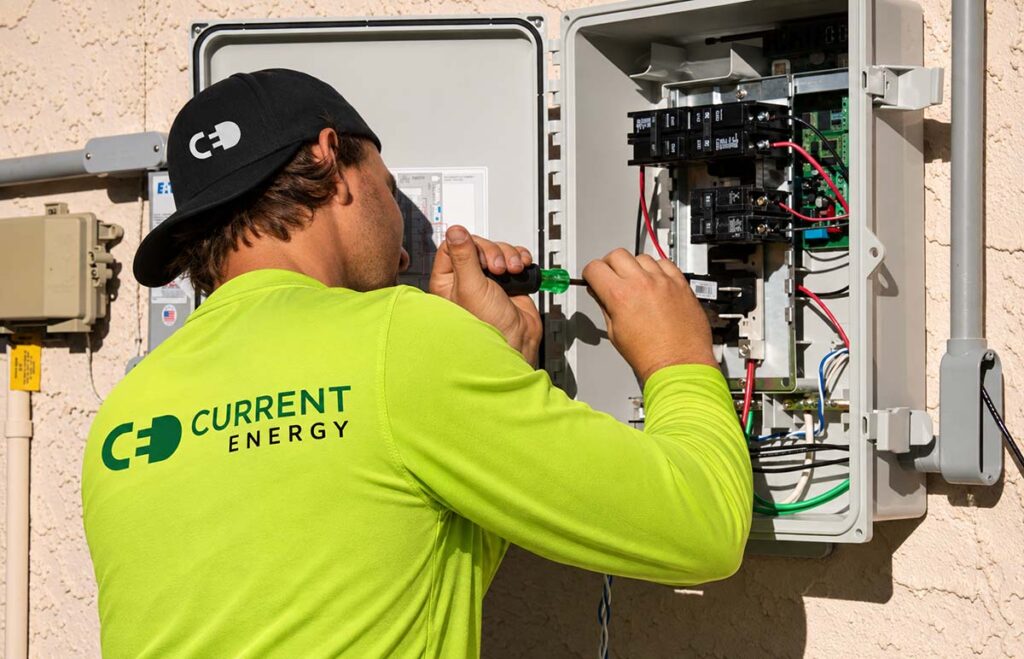
This is one place where having the solar and electrical sides under the same roof helps. Current Energy does both. We can look at the solar project without pretending the rest of the electrical system stops at the panel door.
So, do you need an electrical panel upgrade for solar?
Maybe. That’s not a dodge. It really does depend on the house.
A good 100-amp system may work. A 200-amp panel may still need some thought. An old panel might need replacing even if the service size stays exactly the same. And if the house is moving toward heat pumps, EV charging, batteries and more electric appliances, a larger service may be worth doing while the work is underway.
The point is to figure out which problem you’re solving before paying to solve it.
If you’re planning solar in Western Massachusetts, southern Vermont or southwestern New Hampshire, Current Energy can look at the solar design and the electrical system together and tell you what the house needs.