
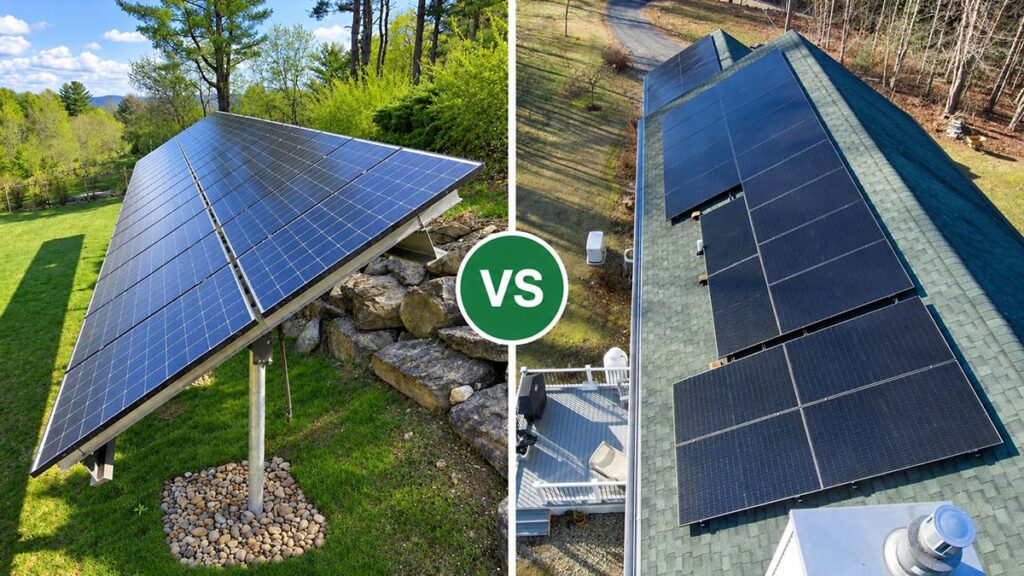
Around here, the roof isn’t always where the best sun is. A house can sit in the shade of maples and pines while an open patch of yard gets sun most of the day.
Then there are the roofs themselves. Some are old. Some face the wrong way. Some are broken up by dormers, chimneys and additions. If you’ve got enough land, a ground-mounted array gives you another place to look.
So this isn’t really a contest between two kinds of solar. It’s a property question: where will the panels work best at your house?
Table of Contents
ToggleWhat is the difference between rooftop and ground-mount solar?
Rooftop solar is just what it sounds like. The panels are mounted to the house, garage, barn or another building. You’re making use of a surface that’s already there, without giving up part of the yard.
A ground mount moves the array off the building and onto its own structure. That means the house no longer gets to dictate the angle, direction or exact location of the panels.
That’s the big distinction. With rooftop solar, you work with the roof you’ve got. With a ground mount, you get to look around the property for a better spot.
When rooftop solar makes sense
If the roof is solid, gets good sun and has enough usable space, there’s a lot to like about putting the panels there.
You aren’t giving up lawn or field space, and you already have a structure to hold the array. That usually makes a roof installation simpler and, all else being equal, less expensive than building a separate structure on the ground.
On a smaller lot, the decision may be even easier. There may not be enough open land for a ground mount in the first place.
But solar is going to be up there a long time. If the shingles are already getting tired, deal with the roof first. Taking panels down for a roof replacement and putting them back up later adds work and expense you can often avoid.
And square footage isn’t the same thing as good solar exposure. A big roof under mature trees is still a shaded roof.
When ground-mount solar makes sense
Ground-mounted solar starts to make a lot of sense when the sunny part of the property isn’t the house.
Maybe there’s an open field behind the house, or a sunny area beyond the tree line. Now the array can be located for the sun instead of being forced to follow a roof that was built decades before anyone was thinking about solar.
That can make ground-mount solar worth considering when:
- the roof is heavily shaded
- the roof is older or otherwise a poor candidate for solar
- the roof does not provide enough usable space for the desired system
- the property has open land with better solar exposure
- the homeowner wants to keep solar equipment off the house
There’s another practical benefit: the equipment is easier to reach when it needs to be inspected or serviced. The tradeoff is pretty obvious. A ground mount takes up land, needs its own structure, and has to be connected back to the home’s electrical system.
Ground mount vs. rooftop solar: the main tradeoffs
Cost
If we’re comparing two otherwise similar systems, rooftop solar usually starts with the cost advantage. The house is already standing. A ground mount needs posts or foundations, racking, trenching and whatever site work the property calls for.
Of course, houses have a way of complicating neat comparisons. A roof replacement, structural work or significant tree work can eat into that advantage quickly. What matters is the cost of the whole job on your property, not a generic roof-versus-ground price.
Solar exposure and orientation
This is where a ground mount gets interesting.
You can’t turn the house. You can’t move the chimney. And you’re probably not rebuilding a dormer because it casts a shadow on a few panels.
With enough usable land, a ground mount gives the designer room to put the array where the sun is better and set the angle without having to follow the architecture of the house.
Roof condition
The panels may be on the house for decades. What’s underneath them matters.
A newer roof in good shape is one thing. A roof you already expect to replace in five or ten years is another. That future roofing job belongs in the solar conversation now.
A ground mount sidesteps that problem.
Land use
This one goes to the roof. It doesn’t take another piece of the property out of use.
A ground mount needs room, and you’ll be looking at it for a long time. Don’t stop at, “Will it fit?” Think about what else happens in that part of the property now, and what you may want to do there later.
Maybe that’s where the vegetable garden goes. Maybe you want to build a garage someday. Maybe it’s the view from the kitchen window. Those things count.
Maintenance and access
No surprise here: equipment at ground level is easier to get to. That can make inspections and some service work simpler.
Panels on the roof stay out of the way, but somebody has to get onto the roof when the array needs attention.
Why the comparison is different in Western Massachusetts
This is where a national pros-and-cons list starts to miss the point. Western Massachusetts has its own set of property quirks.
Start with the trees. We have a lot of them. A roof can be perfectly sound and still spend too much of the day in shade from mature maples, oaks or pines. Move fifty or a hundred feet across the property and the solar exposure can be a different story.
Then there are our houses. Western Mass has plenty of older homes, and they don’t always come with one simple roofline and a modern electrical system. Additions, slate, old service equipment and years of changes can all become part of the solar decision.
The flip side is that once you get outside the denser centers, a lot of homes have some acreage. That makes ground mount a real option. Still, an open patch of grass isn’t automatically a solar site. A steep slope, wetlands, setbacks, zoning or a long trench back to the electrical service can change the plan.
Massachusetts law puts limits on how far a municipality can go in restricting solar, but local rules still matter. UMass Amherst points specifically to setbacks, slope restrictions and wetlands as issues that can affect ground-mounted arrays. Better to find those things out while you’re choosing a site, not after you’ve fallen in love with one.
What about snow and a New England winter?
Cold isn’t the problem people sometimes assume it is.
Solar panels can work quite well in cold temperatures. Snow is different: if the panels are covered, sunlight can’t reach them and production drops until the snow sheds or melts. That’s one reason we look at solar production over the course of a year instead of judging a system by a snowy week in February.
A ground mount gives you more freedom with tilt, which can help snow slide off. It’s also easier to reach. That doesn’t mean you should head outside with a roof rake every time it snows.
We’ll get deeper into snow, cold weather and ground mounts in a separate article.
So which one is better for your property?
If you’ve got a good roof with good sun and enough room, rooftop solar is hard to argue with. The space is already there, the yard stays yours, and there’s less structure to build.
But if the roof is shaded, facing the wrong way, getting old or just too small, look around the property. A sunny piece of open land may be the better solar site.
Sometimes both work. Then it gets more personal. How much solar do you need? What do you want to spend? Do you care about seeing the array from the house? Are you planning a roof replacement or another building? That’s when a site visit earns its keep.
For homes in Western Massachusetts, southern Vermont and southwestern New Hampshire, we’d rather start with the property than walk in with an answer already picked.
Current Energy installs both rooftop and ground-mounted systems. We can look at the roof, walk the property, check the sun and electrical service, and tell you what makes sense. And if the roof is the better place, we’ll tell you that too.
Not sure which way to go? Start with the property. The answer is usually there.
[Request a Quote]