Most folks don’t sit around pondering energy categories. But ask anyone thinking about solar panels, and it usually comes up: Is sunlight renewable or not?
The short version? It is. But that answer doesn’t mean much without context. Renewable energy isn’t just a label—it’s about how long it lasts, how we use it, and what kind of mess it leaves behind. And sunlight? It’s not going anywhere. That’s the whole point.
What Does Renewable Really Mean?
People love to throw this word around—renewable. Clean. Sustainable. All nice-sounding terms. But when it comes to energy, it boils down to one thing: Does using it use it up?

Fossil fuels—coal, gas, oil—are a one-shot deal. Burn it once, and that’s it. Gone. That fuel took millions of years to form, and we’re going through it like it’s infinite.
Sunlight? Whole different story. We can’t use it up. Doesn’t matter if you’re running a massive solar farm or a single rooftop array—your system doesn’t drain the sun. It just catches the rays, turns them into electricity, and lets the rest keep shining.
Why Sunlight Stays on the List
There’s no tank to refill. No mine to dig. Sunlight hits your roof whether you use it or not. That’s why it’s considered a renewable resource—it keeps showing up.
And we’re not burning anything here. With PV panels, we’re just converting light into usable energy. That’s it. No flame, no exhaust, no fuel truck rolling in on Tuesdays.
It’s also part of why solar energy is clean. You install the system, and after that? No carbon. No smoke. No mess. You get electricity, and the sun keeps doing its thing. That’s a pretty good deal.
How Solar Panels Use Sunlight to Generate Electricity
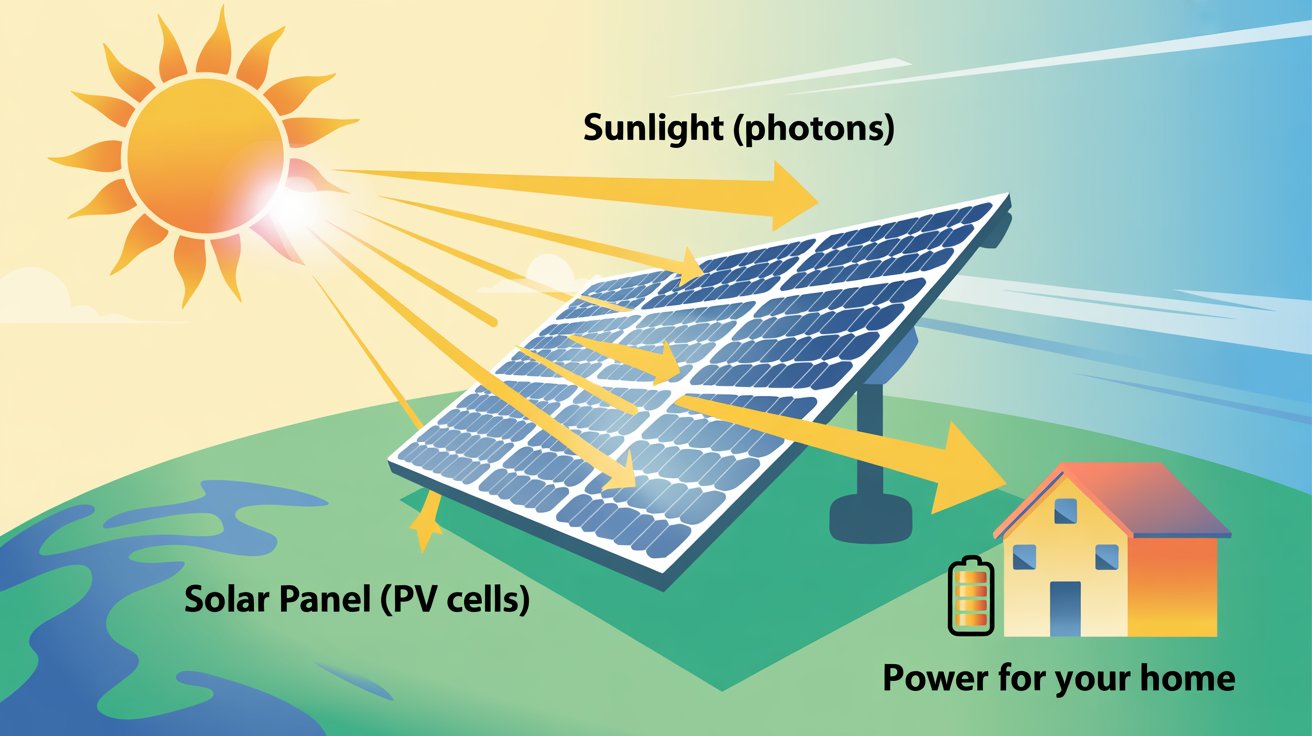
You don’t need to geek out on circuit diagrams to benefit from solar. But here’s the rough idea, in plain terms:
Sunlight hits the panel. That’s the start. Inside those panels—photovoltaic cells, if you want the jargon—there’s a reaction. It’s not magic, but it’s close. The sun’s energy hits a surface, and tiny charged particles—electrons—start moving.
That movement? That’s where the power comes from. Not fire. Not spinning turbines. Just sunlight turned into electricity, right there on your roof.
From there, the current runs through an inverter. That’s the piece that turns it into usable power for your home. Some setups feed extra power back to the grid. Others store it in a battery so you’ve got electricity after dark.
You’re not burning fuel. You’re not drawing from a tank. You’re just turning light into power—solar energy production, minus the mess. As long as the sun shines, the system works. Doesn’t get more renewable than that.
Comparing Sunlight to Other Energy Sources
Think about where your power comes from.
With coal or natural gas, we’re burning through stuff that took thousands of years to form. We dig it up, burn it once, and that’s the end of it. Doesn’t grow back. And it brings problems with it—pollution, runoff, greenhouse gases, the whole package.
Sunlight’s different. Nobody’s drilling for it. It’s not stuck underground. It just shows up—on rooftops, on fields, even on cloudy days. Doesn’t matter how much solar energy reaches the Earth; we’re not running out.
The Department of Energy once estimated we could power the entire U.S. with solar, and it wouldn’t even dent the supply. That’s not something you can say about oil or coal.
So if you’re comparing renewable and nonrenewable energy? Here’s the honest split: One takes effort to find and causes harm when used. The other just… arrives.
Here’s how they compare in plain terms:
| Energy Source | Renewable? | Pollution? | Resource Depletion? |
|---|---|---|---|
| Sunlight | Yes | Minimal | None |
| Coal | No | High (CO₂, particulates) | Yes |
| Natural Gas | No | Moderate to High | Yes |
| Wind | Yes | Minimal | None |
We’re not saying sunlight can do it all by itself. But if you’re weighing your options, energy sources like sunlight are about as low-impact as it gets.
What Makes Solar Power a Clean Energy Option?
There’s a reason so many solar installations come with a feel-good glow—and it’s not just the savings.
First off, there’s no fuel. You’re not shipping gas, digging wells, or cracking rock. Just panels, wires, and some sunshine. That alone cuts out a chunk of the carbon footprint compared to fossil fuel plants.
Second, there’s no smoke or soot. Solar energy is a renewable with virtually zero emissions during use. No tailpipe, no chimney, no leaks. The electricity generated by a typical residential system doesn’t just offset your bills—it offsets the environmental impact of traditional power sources.
And third, it sticks around. Panels last 25–30 years, and many are now built with recyclable materials. So even down the line, the footprint of solar stays smaller than most.
If we’re serious about a sustainable future, this is part of how we get there. Not the whole answer—but one of the better ones on the list.
Is There a Catch?
Every energy source has tradeoffs. Solar’s not perfect—but compared to most options, the list of downsides is short.
The big one? You need daylight. No sun, no power. That’s why most systems either connect to the grid or include batteries, so you’re not left guessing at night or on a string of rainy days.
The second is space. Not everyone has a big open roof, or land to spare for solar fields. And sometimes trees get in the way. Still, solar modules are more efficient than they used to be, and most homes have enough solar exposure to make it work.
Then there’s cost. Installation isn’t free. But between falling panel prices, smart design, and federal tax credits, it’s more cost-effective than it used to be. And once it’s installed? You’re making your own electricity, not renting it from the grid.
Long-Term Sustainability and Environmental Impact
The way we power our lives has ripple effects. That’s true whether we’re talking about fossil fuels like coal, or cleaner energy sources like solar.
With solar energy production, you don’t burn anything. You’re not releasing greenhouse gas emissions every time you flip on a light. And since there are no moving parts in the panels themselves, the system doesn’t wear down in the same way as combustion tech.
Yes, panels take energy to manufacture, and some materials aren’t perfect. But most are built to last 25+ years—and many can now be recycled when they’re done. That’s a big shift from even a decade ago.
The biggest environmental upside? Solar doesn’t rely on a finite resource. There’s no extraction, no pipeline, no leak risk. You harness the sun’s rays, and they keep coming. Every day. For free.
So… Is Sunlight Renewable? Yes. And It’s Also Smart.
It’s not just that sunlight is a renewable energy. It’s that it shows up whether we use it or not. That makes it an energy source we’d be foolish not to use.
With every photon that hits your roof, your system can generate clean electricity. No smoke. No ash. No refill required.
The gear’s come a long way since the early days. PV panels now hold up in real weather—sleet, snow, hot July rooftops. We’ve put them on barns in Deerfield, ranches in Brattleboro, and second-story colonials out in the hilltowns. Doesn’t matter if your roof’s flat or steep, old or new—there’s usually a way to make it work.
If you’re a homeowner in Western Mass trying to keep costs down and do right by the planet, solar’s one of the few options that pays off both ways.
And no, it’s not the full answer to our energy problems. But when you stack it next to other energy solutions, solar holds its own. It’s stable. It’s local. It works for homes and businesses alike. And it leaves the door open for a more sustainable future.
You won’t see the sun’s fuel gauge drop when you plug something in—but your energy produced will tell you it’s working.
FAQ: Sunlight and Renewable Energy
Is sunlight renewable or non-renewable?
Sunlight’s as renewable as it gets. It doesn’t run out, doesn’t get “used up,” and doesn’t care how many homes or buildings have panels. The sun’s rays hit the Earth every day — no matter what we do with them. You can cover your roof in panels, generate power all day, and the sun still shows up tomorrow, same as it ever did.
How long does solar energy take to renew?
It doesn’t need time to renew — it’s constant. The solar energy hitting your panels now took just over eight minutes to reach Earth from the sun. There’s no lag, no recharge period. The source replenishes continuously, as long as the sun shines.
Why is sunlight considered a renewable energy source?
Because using it doesn’t take anything away. You’re not digging into the ground or tapping a limited supply. You’re just catching photons, turning them into electricity, and letting the rest pass by. It’s a clean energy source that’s been showing up for thousands of years, and will keep showing up long after us.
What is the cleanest energy source?
Depends on how you define clean. Wind, solar, and hydropower all generate electricity without burning fuel or releasing greenhouse gases. But solar’s the easiest to scale for homes and businesses — you don’t need a river or a mountain ridge. Just a roof and some daylight.
What’s the environmental impact of solar?
There’s a footprint to make the panels — mining, manufacturing, shipping. But once they’re up, they run clean. No smoke. No waste. Just quiet electricity generation for 25–30 years. Compared to fossil fuels like coal, it’s a night-and-day difference. And newer solar modules are getting easier to recycle, too.