
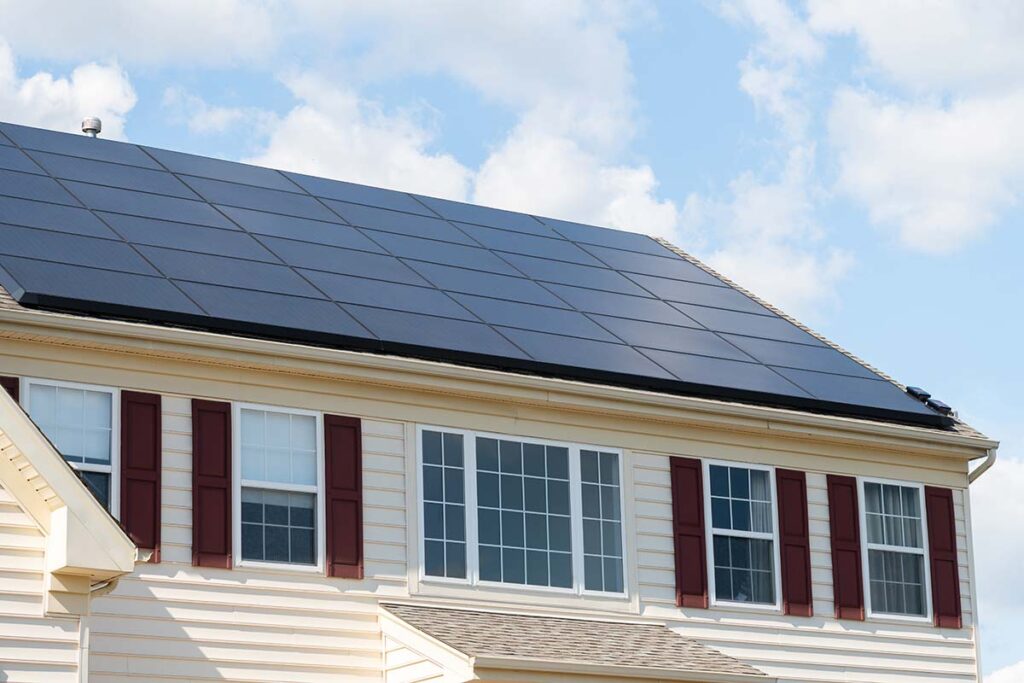
If you live here, you’ve already seen it on your own statement: electric rates in Massachusetts sit well above the national average, and they haven’t been moving in your favor. At the same time, gas prices have jumped by roughly a dollar a gallon in the past couple of months, and fuel‑linked costs like fertilizer and freight are climbing right alongside them. Solar power for residential homes in Western Massachusetts isn’t about chasing a fad anymore. It’s about taking one piece of that picture—the electricity line—and making it more predictable.
We’re Current Energy. We install solar and storage for homes along the Route 2 and I‑91 corridors and out into Franklin County. When we talk about Western Massachusetts solar power for residential customers, we’re talking about what happens to real bills on real houses, not an idealized spreadsheet.
Table of Contents
ToggleWhat solar can actually do to your bill here
Most people come to solar with a rough hope: “I’d like this bill to be smaller.” That’s fair, but it’s not the whole story. In Western Mass, solar changes your bill in a few specific ways that are worth understanding.
First, it cuts how many kilowatt‑hours you buy
During the day, your panels produce electricity that runs your home first. Lights, fridge, well pump, mini‑split, home office—it all pulls from that solar production before touching the grid. Every kilowatt‑hour you produce and use on‑site is one you don’t buy at Western Massachusetts retail rates.
Second, it earns credits when you make more than you use
When your system produces more power than you’re using at that moment, the extra flows back to the grid and earns credits under net metering. Those credits reduce what you owe later, usually on days or months when your usage is higher than your production.
Third, it smooths out the worst spikes
Solar doesn’t eliminate seasonal swings, you’ll still see higher usage when the AC or heat pumps are working hard, but it does flatten the sharpest peaks. For many households, that’s what makes the bill feel less unpredictable, even if it doesn’t hit zero every month.
The exact impact depends on how you use power and how we size the system. A small, carefully sized array on a modest home might shave a steady chunk off the bill. A larger system on a usage‑heavy home can transform the way the statement looks over the year.
Why high Western Mass rates make each kilowatt‑hour matter more
Because our region’s rates are already high, every kilowatt‑hour you offset with your own production is worth more here than it would be in a cheaper state. When you’re paying around 30 cents per kilowatt‑hour, trimming a few hundred kilowatt‑hours a month adds up quickly.
At the same time, you’re dealing with external costs you can’t control: fuel for the car, higher shipping baked into everything you buy, and—if you’re on oil or propane—more money going into the tank just to keep the house livable. That combination is what pushes many Western Mass homeowners toward solar now, even without a new federal residential credit in play. You’re not chasing a tax perk. You’re trying to get off at least one moving target.
What matters more than people realize: your usage pattern
Two homes with the same roof can get very different results from the same system if they use power differently.
A few patterns we see a lot:
- Homes that use most of their electricity during the day: people working from home, shops attached to the house, or families with staggered schedules. These tend to see strong immediate benefit because they’re using solar power right as it’s generated.
- Homes that pull heavily in the evening and at night: families who come home, cook, run laundry, and plug everything in after dark. These still benefit through net metering, but their “self‑consumption” during the day is lower.
- Homes that recently added electric heat, heat pumps, or an EV: usage has jumped, and the bill shock is fresh. Here, we’re often sizing a system around the new reality, not last year’s bills.
We read your usage history and ask about upcoming changes before we design anything. That’s how we get from “solar should help” to “here’s how this particular system interacts with your bill.”
Roof, shade, and why we sometimes leave space empty
People often assume “more panels = better.” In Western Massachusetts, that’s not always true.
Older roofs, complex shapes, and heavy shade can make some roof sections poor candidates for solar. We’ve seen plenty of cases where the best financial and practical outcome came from:
- Using the cleanest, most sun‑exposed plane for the main array.
- Leaving heavily shaded or awkward areas alone instead of forcing panels into spots that rarely see direct sun.
- Planning for future changes—tree work, a roof replacement, or a ground mount down the line—rather than treating this year’s design as the last chance to add capacity.
Your bill doesn’t care how many panels you can see from the driveway. It cares how many good kilowatt‑hours those panels produce over the next couple of decades.
Bills before and after: what homeowners usually notice
When people ask “what does it look like after solar?”, they’re not asking about a model. They’re asking about mail.
Common changes Western Mass homeowners report:
- The total owed drops, but the structure of the bill still looks familiar: delivery, supply, fees, and so on. Solar doesn’t erase the utility; it changes how much you lean on it.
- The seasonal peaks become less intimidating. Winter and summer bills still rise compared to shoulder seasons, but the swings aren’t as violent.
- Net metering credits show up and roll from month to month, sometimes wiping out most of the supply charge in lower‑usage periods.
If we’ve sized the system conservatively, you’re likely to see a substantial reduction rather than a perfect zero every time. That’s on purpose. It’s usually better to cover a realistic portion of your usage consistently than to chase a flattering but fragile bill screenshot.
Where batteries fit into “what changes your bill”
Batteries aren’t required for solar to help your bill, but they do change how you experience power in a place where outages and rate complexity both matter.
In Western Massachusetts, adding a battery to a residential solar system can:
- Keep heat, lights, and key circuits running during outages, which doesn’t show up as a line item but absolutely shows up in quality of life.
- Let you store midday solar production for evening use, increasing how much of your own power you consume directly.
- In some cases, allow you to shift some usage away from the most expensive times, depending on how your utility structures rates.
We treat storage as part of the overall “energy plan” for the house, not as a mandatory add‑on. For some homes, it’s a clear fit. For others, clean solar plus a simple backup strategy is enough.
When Western Massachusetts solar power for residential homes is a good fit
Solar is not a universal yes. There are homes where the roof, shade, or usage pattern just don’t line up. But a few signals tell us you’re likely in the “this deserves a close look” group:
- Your electric bills feel high enough that trimming a chunk would matter month after month.
- At least one roof plane has decent remaining life and a reasonable shot at the sun.
- You expect to stay in the house long enough to care what your energy costs look like five or ten years out.
- The idea of paying some of the highest electric rates in the country indefinitely, while gas and fuel‑linked costs jump, doesn’t sit well.
If that sounds like your situation, Western Massachusetts solar power for residential use is less about chasing an incentive that’s gone and more about changing the shape of your energy budget going forward. The panels are just the visible part. The real change shows up every month when the bill arrives and you don’t feel quite as exposed to whatever the utility and global markets decide to do next.